A Short Story to Start
Before. You’ve seen this happen, maybe even in your own contact center. Jasmine is hired, bright and warm, eager to start. Her first week is filled with HR paperwork, a welcome video, compliance modules, and long stretches of PowerPoint training. She meets the management team once in a large group. The trainer becomes her main point of contact.
By Week 2 Jasmine started a few role-plays and is reassured: “Don’t worry, you’ll get the hang of it once you’re on the phones.”
By Day 17, with only a couple of practice sessions behind her, Jasmine shadows a veteran agent. When she admits the billing tool feels like a maze, she hears the same message again: “Don’t worry, you’ll get the hang of it.”
Jasmine’s first solo call confirms her fear. She finds the right answer but freezes on the navigation. Her voice shakes, the customer leaves frustrated, and so does she. QA notes are encouraging, but the pace leaves little time for coaching.
Jasmine’s team leader tells her the jitters will pass once she takes more calls. But she isn’t sure anymore if this is the kind of work she wants to do.
By Day 45 Jasmine is gone. A good person lost, a seat to fill again.
Many centers, what we have seen and learned about, see a quarter or more of new hires leave within three months.
After. Let’s change the story. At a center where I recently consulted, we hired Jake. Before Day 1, he was given a clear preview of the role: the real screens, a sample call recording, and a short work exercise. He knew what he was walking into, and he chose it with open eyes.
On Jake’s first day he was introduced to his buddy, someone he could turn to for quick questions and real talk. His manager told him, “People are the heart of this center. Our job is to help you do the best work of your career.” That set the tone.
By Week 2, Jake wasn’t just listening, he was practicing with short, realistic scenarios that mimicked the messy reality of live calls. He drove the tools, heard how he sounded, and tried again until it felt natural. An AI copilot supported him during live practice, surfacing the right step when he needed it most.
The most effective managers see the first 90 days as a relationship, not a checklist.
When Jake took his first solo call, he still felt the nerves, but he had practice behind him. He moved smoothly through the system, recovered quickly when the customer’s tone shifted, and ended the call with confidence.
QA praised both Jake’s accuracy and his empathy. Coaching time was built into his week, so feedback became part of his rhythm, not an afterthought.
By Day 60, Jake was steady and reliable. By Day 90, he was mentoring the next new hire.
Every new hire can have Jake’s experience, not Jasmine’s, if we take a few heart-focused steps. I’ll share those steps in a moment. First, let’s ground ourselves in the hard truth: why the first 90 days break so many centers, what it costs, and why I know your leadership team will applaud your focus.
Why the First 90 Days Break Us (And Its Costs)
Turnover is still the industry’s headline. A 2025 report from NiCE and SMG, “Managing the Modern Contact Center: Current Employer Trends”, found that attrition averaged about 39% in 2024: an improvement from 49% the year before, but still far too high.
The dollars are real. Replacing a single agent can cost $10,000 to $20,000 once you factor in recruiting, training, and productivity loss. Customer satisfaction and first call resolution (FCR) also take a hit when tenure walks out the door.
The most damaging attrition happens early. Many centers, what we have seen and learned about, see a quarter or more of new hires leave within three months.
Give new agents meaningful practice and humane schedules.
The root cause is not usually the contact center work itself, but how we introduce people to it. When we honor their time, paint the whole picture, hire for emotional intelligence, and coach them as if they matter, they stay and serve customers better.
How to Spot If It’s Happening to You
Look beyond annual attrition reports. Early warning signs include:
- Candidates accept offers but don’t show up on Day 1.
- Day-30, -60, or -90 quit rates run high.
- New-hire handle times aren’t improving.
- Exit interviews mention “job not as expected.”
- Buddy or manager check-ins are skipped.
If two or more of these are present, you have an early attrition problem and a chance to fix it.
The Manager Mindset: People First, Then Process
The most effective managers see the first 90 days as a relationship, not a checklist. Here’s a people-centered playbook to reframe that time.
1. Paint the Whole Picture
Show candidates what the job really looks like. Share tool screens, a call recording, and a short work exercise. Clear previews reduce early attrition because people feel they were dealt with openly.
2. Hire for Heart
Technical skills can be trained; empathy is harder. Structured interview questions and short scenario tests, often called situational judgment tests, help reveal emotional intelligence. People with strong emotional intelligence not only perform better but also report less stress.
3. Make the First 90 Days an Experience
Orientation is an event; onboarding is a journey. Strong centers design the first three months as an experience. A buddy program ensures new hires have a peer guide. Weekly 15-minute manager check-ins focus on wins and blockers. Small “purpose moments,” like hearing a customer success story, connect the dots to why this work matters.
4. Practice Like It’s Live
Realistic practice sessions — whether delivered through technology-based simulations or well-designed role plays — help new agents ramp up faster, especially when the work is complex. Build scenarios around your top five failure points and let agents practice navigating systems, handling tough tones, and thinking on their feet.
Whenever possible, give learners the chance to record and replay their practice. A quick debrief with a coach or buddy turns each session into a meaningful learning moment. Three short practices per week in the first month can accelerate confidence dramatically.
5. Flexibility as a Foundation
Flexibility isn’t a perk; it’s a safety valve. Nearly half of centers that offer flexible scheduling report lower attrition. That might mean micro-shifts (i.e., a shorter, more flexible work block), self-service swaps, or recovery breaks after complex intervals. It also means separating metrics by channel, so a voice call isn’t measured the same way as chat.
6. Show the Path to Growth
One of the top reasons agents leave is the belief they can’t grow. By Day 30, share visible skill tiers and career paths. By Week 6, give each new hire a small project, such as writing a knowledge article or shadowing a different channel. Growth doesn’t always mean promotion; it means being seen as capable.

Closing Thoughts
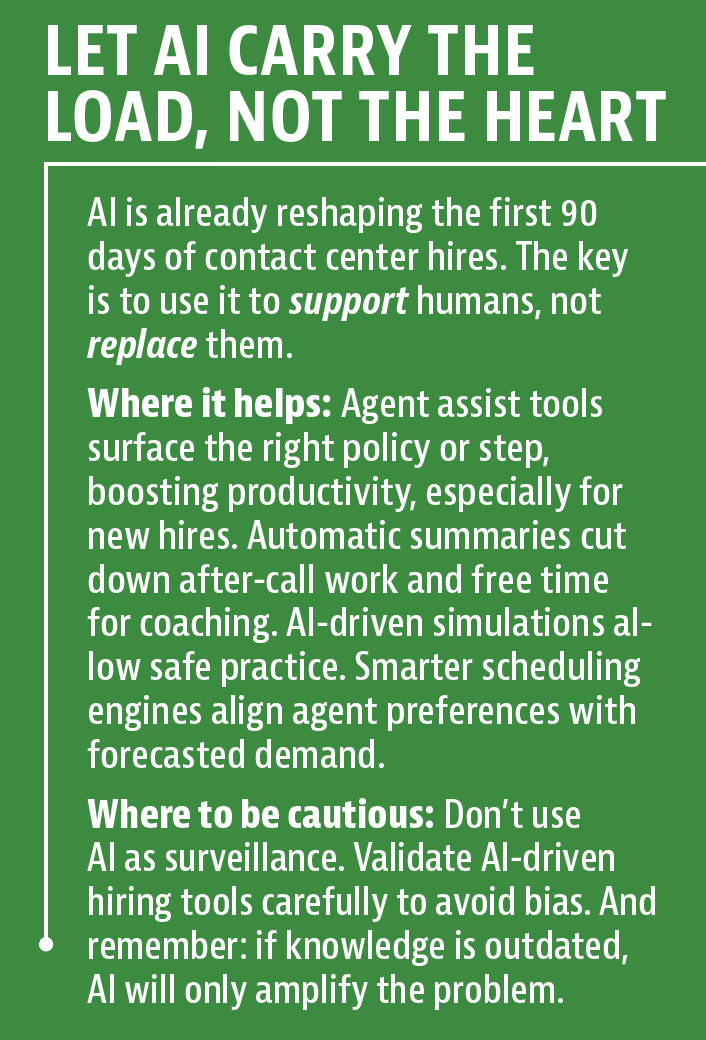
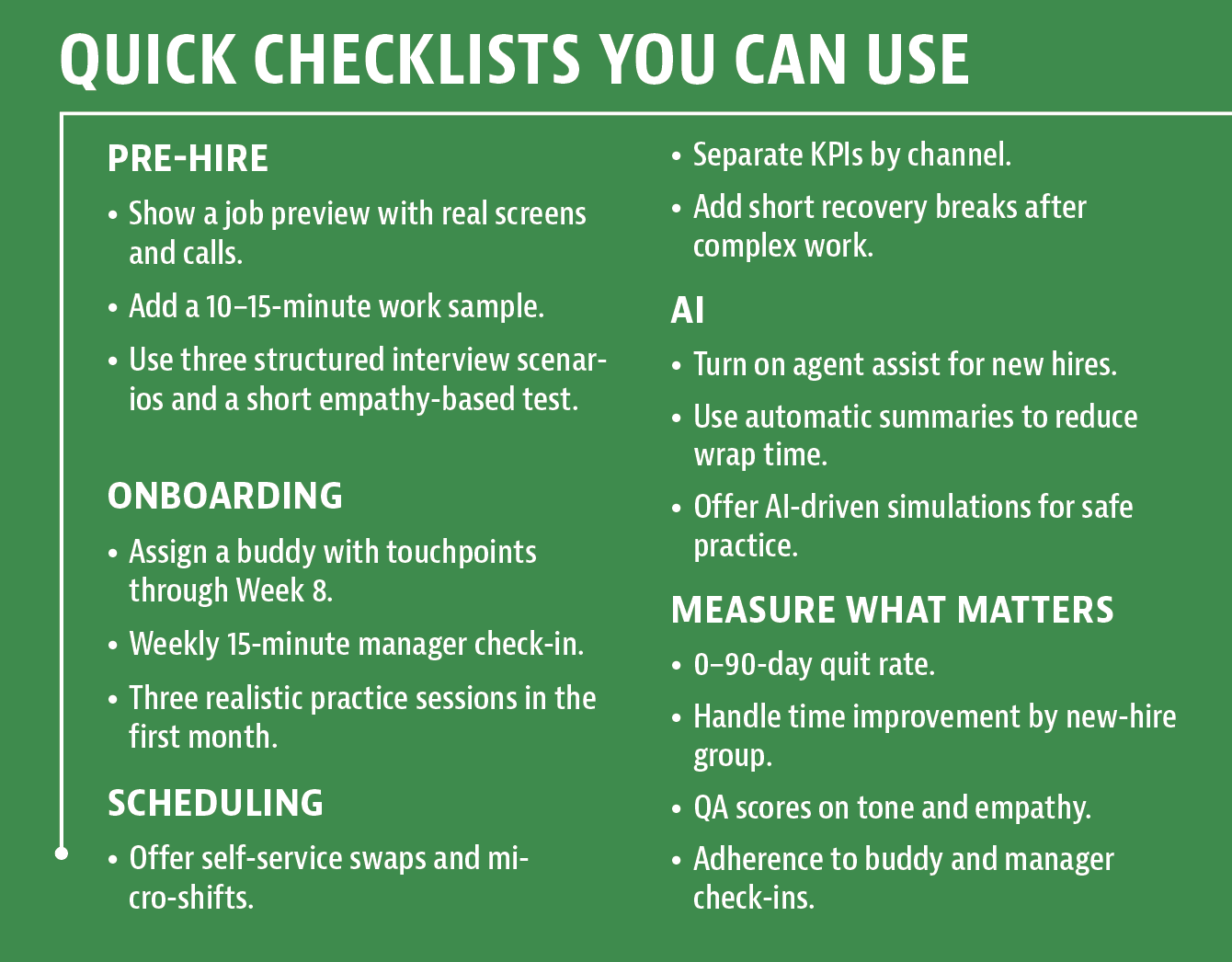
Our people are the heart of the contact center, and the first 90 days are where we prove it (see FIGURE 1). Show the real job. Hire for heart. Give new agents meaningful practice and humane schedules. Let AI carry the busywork so people can carry the customer.
With your next new hire group, don’t overhaul everything. Try just two steps: give a late-stage preview with a short work sample, and schedule three short practice sessions a week. You’ll see confidence grow, attrition ease, and stories like Jake’s become the rule, not the exception.