• Skip to primary navigation
  • Skip to main content
  • Skip to primary sidebar
  • Skip to footer

Technology Newsroom

  • Home
  • About Us
  • Electric Vehicles
  • Solar Power
  • TechNews
  • Resources
  • Contact

The Latest Technology News

Solar Power

Next ISS Crew’s Agenda Includes Solar Power Upgrade


Next ISS Crew’s Agenda Includes Solar Power Upgrade | Aviation Week Network


https://aviationweek.com/themes/custom/particle/dist/app-drupal/assets/awn-logo.svg


Skip to main content


Artist’s concept of spacecraft using ROSA.

Credit: Space Systems Loral (SSL)

HOUSTON—As the NASA-led International Space Station (ISS) partnership strives to push the science and technology development potential of the orbital science lab, astronauts assigned to missions through 2023 will be equipping six of the station’s solar power channels with new Roll Out Solar Arrays…


Next ISS Crew’s Agenda Includes Solar Power Upgrade is published in Aerospace Daily & Defense Report, an Aviation Week Intelligence Network (AWIN) Market Briefing and is included with your AWIN membership.

Already a member of AWIN or subscribe to Aerospace Daily & Defense Report through your company? Login with your existing email and password.

Not a member?  Learn how you can access the market intelligence and data you need to stay abreast of what’s happening in the aerospace and defense community.
SolAero Technologies’ Solar Panel Powers NASA’s Mars Helicopter

ALBUQUERQUE, N.M., April 19, 2021 /PRNewswire/ — SolAero Technologies Corp. (SolAero), a leading provider of high efficiency solar cells, solar panels, and composite structural products for satellite and aerospace applications, congratulates the team at NASA’s Jet Propulsion Labs (JPL) on the successful maiden flight of the Mars Helicopter, Ingenuity. SolAero is proud to have supplied the solar panel that has enabled the first powered, controlled flight on another planet.

The solar panel for Ingenuity was manufactured in SolAero’s state-of-the-art production facility in Albuquerque, NM. The panel is populated with SolAero’s industry-leading, 33.0% efficient IMM (Inverted Metamorphic Multi-junction) class of solar cells that generate in excess of 10% more power than other space solar cells in production today. The IMM is also more than 40% lighter than typical space grade solar cells.  The combination of higher efficiency and significantly lower mass was a critical factor that was deemed mission enabling for Ingenuity’s successful flight.

The success of Ingenuity further extends SolAero’s long history of powering satellites and spacecrafts for NASA and JPL, including the Mars 2020 Cruise Stage, the InSight Lander that is currently operating on the Mars surface, the DAWN asteroid mission, the Parker Solar Probe to the sun, the Lunar Atmosphere and Dust Environment Explorer (LADEE) mission and many others.

“SolAero is extremely proud to be a part of this history-making flight and supporting it with the highest performance solar panels available,” said Brad Clevenger, CEO of SolAero Technologies. “SolAero’s industry leading technology and track record of performance continue to make it the supplier of choice for the most demanding satellite applications.”

About SolAero Technologies Corp.
SolAero Technologies is a leading provider of satellite solar power solutions and precision aerospace structures to the global space markets, encompassing a wide array of applications including civil space exploration, science and earth observation, defense intelligence and communication, and commercial telecommunications industries. The business was founded in 1998 and is headquartered in Albuquerque, New Mexico, USA. For more information about SolAero, visit https://solaerotech.com/

About NASA/JPL
The Jet Propulsion Laboratory is a unique national research facility that carries out robotic space and Earth science missions. JPL helped open the Space Age by developing America’s first Earth-orbiting science satellite, creating the first successful interplanetary spacecraft, and sending robotic missions to study all the planets in the solar system as well as asteroids, comets and Earth’s moon. In addition to its missions, JPL developed and manages NASA’s Deep Space Network, a worldwide system of antennas that communicates with interplanetary spacecraft. JPL is a federally funded research and development center managed for NASA by Caltech. For more information about JPL, visit https://www.jpl.nasa.gov/

Contact:
Ms. Maggie Smith
Corporate Marketing Communications Manager
(505) 463-1732
[email protected]

SOURCE SolAero Technologies Corp

Related Links

http://www.solaerotech.com

Solar O&M Gets Set For The Big League In India

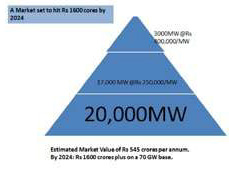
As India’s solar footprint has grown, from a tentative 3.7 GW in 2015 to over 40 GW now, a little appreciated, but growing opportunity is finally getting its place in the sun too. The Solar Operations and Maintainance (O&M) business.

solar o&m

A $4 billion business worldwide in 2019, it is set to be a $9 billion business by 2024.

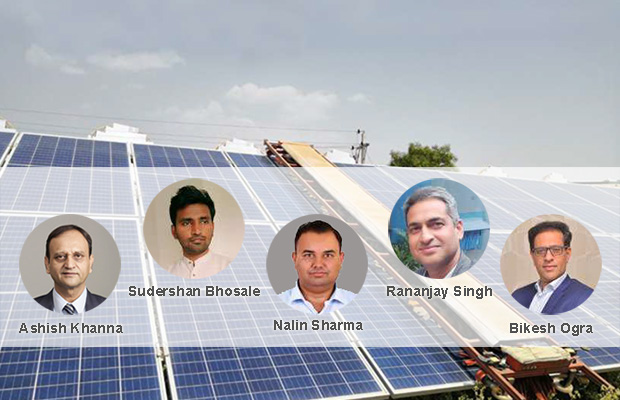
Long divided between developers doing ‘self-maintenance’, EPC contractors and Independent operators, it is the latter that could potentially come into their own in the next wave of contracts and changes. Or as Ashish Khanna, President-Renewables, Tata Power told us, “We are convinced that once most of the projects in pipeline and those already announced then O&M services of Solar will have similar to IT industry potential in terms of business opportunity”.

solar o and m viewFor firms in India, the new opportunities in Solar O&M are real. Not only is there a growing domestic market, but learnings here can also potentially open up opportunities globally. That is because, like many other businesses linked to the solar sector, the focus here is on lowering costs and technology upgrades. Of course, like any new opportunity, the players are also many, including small local players. States like Rajasthan and Gujarat, where a lot of large projects are coming up now, have an especially high number of local players vying to win O&M work, making it a very competitive business indeed. However, at this stage, we have refrained from going into a listing of the top players, catch that in a future issue of Saur Energy.
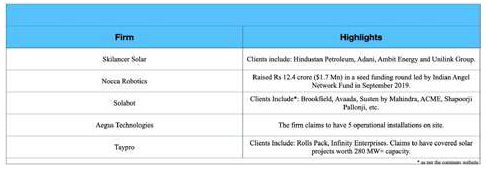
For Sterling and Wilson Solar limited, the leading global EPC firm in solar from the Shapoorji Group, the O&M business is more than just a business opportunity. O&M earnings can also smoothen out its revenue flow, unlike the lumpy EPC business. And it has used its international presence to make inroads here too.

Speaking at its analyst call in February, Bikesh Ogra, Director, and Global Chief Operating Officer said “ Coming to operation and maintenance business, we currently manage around 8.1 gigawatts as our portfolio; we have acquired a substantial amount of third-party operation and maintenance business for India. On the international front operation and maintenance market for those projects where the EPC was undertaken by third-party companies is expected to grow in the coming financial year. Our objective is to acquire an additional third-party O&M portfolio of at least 1 gigawatt each in the domestic and international market for FY2022, this obviously would be incremental to our regular self-EPC executed O&M business. I am very happy to share that we have recently won our first O&M project outside India on a competitive basis in Oman.”

The firm’s CFO added that O&M revenue increased by 27% to Rs 180 crores in the nine months of FY2021 compared to Rs 132 crores in the corresponding period of FY2020 with an EBIT margin of 36.9%. For SW Solar, the O&M business contributed 4.8% of revenue in nine months FY2021 as compared to 3.8% in nine months FY2020. With a positive margin impact, since the EPC business rarely crosses 10-11 percent margins.

2.8 GW O&MRananjay Singh, Head of Marketing at Gensol Power Group, whose 2.8 GW O&M portfolio makes them the largest Independent Service provider in the space, agrees on the potential.

“Solar O&M is a growing business and set to grow well going forward. If you consider the majority of large projects today, most started coming up post-2017-18. Most contracts come with a defect liability period of between 3-5 years. If we consider a 5-year exit clause, the majority of these assets will come into the market by 2022-23. Plus the 30 GW project pipeline currently. That is a very large market up for grabs”.

Singh however has a warning for firms eager to get in.

“We expect to see more competition because the barriers to entry are not very high in O&M. However, margin pressures will remain. We are happy to work with even 3-5percent margins, as long as there is a bonus clause in the contract linked to say plant output or low downtime.”

Add to that, people going for multiple contractors instead of EPC. So O&M contractor can pitch in from day 1.

Ashish Khanna of Tata Power, which manages its own O&M in-house, adds his own firm’s view. “Tata Power has more than 2.6 GW of its own assets and 1.2 GW under its operation & maintenance management program. With highest level of plant performance being our focus, we have an average availability of more than 99.9% for most of our plants.

We have our own Central Control Room for Renewable Assets (CCRA) to centrally monitor and undertake predictability analysis of our assets and similarly for the operations and maintenance of solar rooftops, we have set up a state-of-the-art network operations centre, giving instant business insights as a value-added service to our customers. We have also developed Apps for our customers of Pumps and Rooftops to overview the performance of the assets.”

What’s New In Solar O&M?

PV Diagnostics, a Mumbai-based solar specialist firm that offers technology, consulting, and advisory for its clients, is very clear on what a solar pant owner should expect a solar OM to deliver.

Compiled by its expert Sudarshan Bhosale, Lead Backend Analyst, and his team, the firm lists the following terms of reference for an O&M contract

  • Generation guarantee terms and associated liquidated damages
  • Plant availability guarantee
  • Warranty terms
  • Cleaning cycles and their maintenance
  • Scope coverage for the O&M of the plant & GSS bay
  • Conditions for effective monitoring and reporting system
  • Documented insurance for an operation period
  • Well-defined clauses for response time, sub-contracting, spares and consumables, etc.
  • Defined qualification for operations team personnel with respect to standard industry practice
  • Preparation and maintenance of records and documents related to work permits, checklists, and SOPs
  • Documentation of training records, LOTO system, proper housekeeping, safe work area, and vegetation clearance
  • Forecasting and Scheduling: Appointment of Qualified Contracting Agency (QCA) & executing QCA agreement; and assessment of F&S, deviation settlement mechanism with offtaker and associated penalties

He adds that the major difference between the Indian and global markets is the requirement of manpower on the site for the O&M activities. “In the Indian solar plants, the manpower requirement is usually high as compared to the other developed nations.”

However, Gensol’s Singh believes this is changing very fast now. “There are two major issues driving change today. One, the business is changing from a conventional manpower service to tech-driven. At the project level, there are anticipated challenges like water usage and rising wage pressures for workers. That is driving firms towards implementing robotic systems for one. Using data and implementing analytics remotely is another way to both improve efficiency and reduce manpower requirements at the site,” he adds.

Tata Power’s Khanna adds that “ to integrate renewable energy with the grid, various state governments have come up with strict scheduling, forecasting and deviation settlement regulations, which penalise over- and under-generation of electricity from renewable energy plants. This has encouraged O&M players to invest in the automation of predictive maintenance services. Efficient and artificial intelligence (AI)-enabled monitoring platforms are already in use for predictive O&M. Use of Drones and mobile vans to evaluate component as well cable level fault detections and rectifications has already transformed this industry”.

Sameer Chaudhary, Senior Manager(Operations) at Amplus Solar highlights the typical exclusions too. “Key exclusions which shall be in the scope of the owner are plant insurance, land lease payments, internet charges, forecasting and scheduling, regulatory approvals, DISCOM payments, CEIG inspection and renewal, factory license, energy meter calibration, payments to state bodies (unless due to negligence of contractor), among others”.

So technology and manpower. And no one would their impact know it better than one of the world’s largest robotic cleaning firms, the Israeli firm Ecoppia. Nalin Sharma, Vice President, Asia and Pacific highlights how until a few years ago, solar O&M was limited to module cleaning, plant security and vegetation removal. “As of today, it has evolved into a stand-alone business vertical. Many 3rd-party O&M service providers now offer a range of services to solar plant developers. An emerging trend we see today in 3rd-party solar O&M is the adoption of automation and digitalisation to reduce project downtime and improve plant performance.

Tech-based solutions and increased automation also reduce O&M costs. The module cleaning and associated manpower costs together constitute the major component for plant O&M costs in India. We see that automation significantly reduces such costs by allowing O&M firms to reduce manpower costs and maintain profitability. Furthermore, O&M firms are moving from corrective and preventive maintenance to predictive and prescriptive analytics-based maintenance performance to reduce downtime and improve operational costs of solar projects.

Sharma adds that firms like Ecoppia have adapted to the new challenges and opportunities “ Cleaning accounts for almost 40 percent of the cost of Solar O&M typically. With the new breed of large utility-scale projects, we believe annual cleaning is simply not an option anymore.”

He’s right. Automation is coming, and not just for cleaning. Deep inroads have been made into plant monitoring, data collection, and analytics, often the difference that wins projects for players today.

In the US and China, we have seen autonomous drone inspections, module-washing robots and robotic lawnmowers already put to use at large projects.

Besides reducing labour costs, in the Covid period, technology products have also aided the protection of staff, besides providing safe and reliable service with low risks. In fact, the low downtime of renewables during the Covid lockdowns and beyond has been a standout feature of 2020 for the sector.

From being tried by a few early adopters, the Covid pandemic has simply accelerated the development process of these tools, as buyer interest has grown. In India, we currently have a clutch of start-ups trying to build a robotic cleaning solution for solar panels and beyond. While some have even received investor funding, others are charging ahead on the back of ever-lower costs and bigger promises.

Analytics platforms today forecast component failures, while drone-based remote monitoring can reduce the need for site visits

The Big Drop. Prices

However, by far the biggest change in Solar O&M has been pricing. Prices have mirrored the fall in module prices, dropping from as high as $12-20/KW in 2015 to barely $5-8/KW now. In India, that has meant a drop from Rs 8 to 10 lacs per MW per annum to Rs 2.5 lacs per MW per annum now.

However, it is not lower module prices and higher efficiency, but a learning curve in other areas that have aided this price drop. From more efficient robotic cleaning options, to better capturing of data and its analysis, to better performance of inverters, especially the newer string inverters, a lot has changed to make the pricing more aggressive.

Ashish Khanna prefers to benchmark solar o&M costs with project capex costs, at 1 percent of project cost, with an annual escalation of 5 percent.

Earlier O&M models used to be all in contracts, covering hardware as well as replacement risk. This was partly because the firms providing O&M services on those smaller projects were also the manufacturers themselves, the EPC contractors and even worked with inverter manufacturers, giving them the confidence to offer such terms. It was also driven by client needs, with most customers not really keen on dealing with multiple vendors with barely a record in sight. With scale, risk has been pushed back to project owners, even as technology finds ever newer ways to provide better inputs.

Ecoppia’s Sharma explains. “As Ecoppia secured over 11.5 GW in this region, we see that most commonly solar sites are faced with construction quality issues, which includes structures, wiring, inverters, and panel degradation from hot spots due to improper cleaning. Ecoppia’s sophisticated cloud-based solution allows site developers full visibility of the site.

robotic cleaning startups

While traveling nightly on the panel the robotic cleaning solution collects millions of data points related to cleaning performance, weather conditions and the correlation between them, using both physical input from the actual site and external data sources such as APIs. Our robust AI platform integrates these multiple data sources and by applying machine-learning layers, can offer an optimal operation while constantly improving our offering and services.”

However, while Independent Service providers Gensol will point to the liquidated damages as a key reason why they hold an edge over in-house teams, others are not so comfortable yet. Both Ecoppia’s Sharma and Gensol’s Singh agree that over 50 percent of large solar capacity is self-maintained. A senior executive at a large EPC developer we spoke to said this on condition of anonymity. “We usually find that our in-house team, thanks to their involvement with the vendor negotiations and technical expertise, can keep O&M costs low. And yes, they are incentivised also to ensure high uptime and output. EPC’s come close on the cost front at times, but we find that they can slack off on maintenance after a year or two, as other pressure points on the business emerge. It is a very competitive business, and with an asset that has a 25 year lifetime, it will take some more time before many of the largest developers trust someone else to manage it.”

However, with financial investor-backed projects increasingly in vogue, the future remains bright for independent service providers as well as EPC’s like Sterling and Wilson Solar, as financial modelling will be decisive in deciding contracts.

On the advantages Gensol brings, Singh of Gensol adds that “when it comes to an analytics model clubbed with our O&M portfolio, it gives us an advantage. He also urges potential developers not to underestimate the value of outsourcing. “In-house O&M can make employees accountable, but you cannot penalise them. Whereas, when you outsource, you can have liquidated damages after 6 months or a year.”

Inverters, probably the most important component after the modules, are a key point of discussion. Most come with a 5 to 10-year warranty, and are the first to require retrofitting. Right now, in a vast majority of the cases, such extension of AMC or overhauling is being done directly by the owner. Besides proprietary items like SCADA.

Currently, some of the biggest developers like Acme, Renew Power, Azure, Greenko are all managing their assets in-house. But as their portfolio sizes expand, expect changes soon, as lower costs linked to guarantees become too attractive to be missed for at least some of them soon. Add to that the new trend seen in some cases, for a developer to contract out the work to multiple vendors, instead of a single EPC. That means the O&M contractor can pitch in from day 1.

What About Smaller Projects and Rooftop Category?

This is where the situation becomes interesting in India. While the share of this category is just about 6 GW out of a total 40 GW of solar capacity, the number of projects are in the thousands, if one considers residential rooftop. Take that out, and you still have a large addressable market. Add to that the fact that even in the residential rooftop market that is subsidy backed, the typical maintenance contract is for 5 years, and you see some real potential.

However, the economics can be very different here.

Amplus Solar’s Chaudhary states that “the cost depends on several factors including soling at a particular location, security situation, quality of water available, location and accessibility, etc. and there are no stringent criteria, but the prerequisites might differ from case to case. However, as per our experience, we can say the overall cost including statutory cost is around 5.5 LPA for RT and around 3.5 LPA for Open Access plants”. That premium is supported by all the other EPC’s we spoke to.

A massive stumbling block of course is the singular focus on costs over everything else, by a majority of owners. Anurag Paliwal, Founder at Infisolar, a Rajasthan-based EPC firm, laments the cost focus as a major reason why solar O&M does not interest him yet. “ Another problem is that many EPC’s at this scale, when they run up against a cost obsessed client, tend to downplay O&M needs and costs, to close the deal”.

PV Diagnostics Bhosale adds that the smaller plants “ surely present an opportunity for O&M companies. However, it is challenging to make these O&M contracts profitable especially for small rooftop solar power plants. For small project sizes, the cost of O&M is approximately the same whether it’s a 5 kW plant or a 20 kW plant, or even more. Therefore, it is important to have multiple plants under management in the same vicinity to make it financially viable. Additionally, the quality of these assets is very different from a standardisation perspective, therefore, its standardization becomes very difficult. Also, PR/CUF commitment becomes a challenge. In recent times, we have seen multiple companies taking up and exiting O&M contracts of rooftop power plants.”

Options like robotic cleaning are also not practical yet for these smaller plants. Paliwal does add that for plants in the MSME sector that are say, sub 500 KW, most firms will usually have their electrical resource at hand, who is usually tasked with maintaining the solar system as well, including warranties and AMC’s on key equipment.

But don’t count out Indian ingenuity to discover a business model for small plants. In the NCR region, we have already heard of some smaller installers offering rates as low as Rs 500/600 per KW per year to maintain smaller plants. Work involves a quarterly visit to clean and check all critical components. With a promise to ‘handle’ any breakthrough in terms of coordination with the manufacturers etc.

NEXT STEPS

With almost all the key requirements in place, the solar O&M market is set to grow with the broader solar sector. Perhaps the only slight disappointment is the creation of lesser than expected jobs, as more and more roles are performed by technology interventions.

However, firms looking to make a splash in this business will need to invest, in both people, technology, and credibility.

As PV Diagnostics Bhosale adds, even where warranties and retrofits are to be managed by owners, the O&M players will have a role to play. “The onus of ensuring warranty lies with the O&M firm to some extent. Some of the warranty terms are associated with the design and installation. Since these phases are not associated with the O&M firm, certain warranty clauses may become void if O&M is not carried out properly. For example, improper handling of modules may result in the breaking of module glass or backsheet scratches, affecting the warranty of the modules. Similarly, there are no standard training procedures related to repairs which can affect the warranty if not executed effectively.”

On the relative advantages and disadvantages of O&M, between an independent O&M specialist versus the EPC or the developer. He adds that with Large EPC player or module manufacturer that also offers O&M, the advantages are:

  • They have a good understanding of the installation of the plant and its design so that they can understand the bottlenecks very well. This will prove beneficial while carrying O&M activities.
  • Since they have a substantial team size, they will have an impeccable cross support system, thus helping in quality data analysis, troubleshooting, and implementing long-term solutions for performance improvements and maintenance of the plant.

An independent O&M specialist will have the following advantages:

  • Large EPC players, or a module manufacturer that also offer O&M might have a certain bias and may look down upon certain issues related to design and modules. This bias won’t be a concern with an independent O&M specialist. This can be a considerable factor in ensuring proper O&M.
  • O&M specialist has a specific focus on O&M related issues which can help in better O&M quality

Amplus’s Chaudhary also has no doubts about the growth potential. “The Solar O&M Market in India is undoubtedly bound to grow, and we shall witness all present mid-size players evolving further and competing with the large established players. The market is only going to expand. With PPA dipping to an all-time low, the market shall be highly competitive and only those with a long-term vision on providing and maintaining quality and prompt service shall fare through.”

As far as the onus of ensuring warranty is concerned, Amplus in all its contracts has entrusted this responsibility of OEM coordination to its contractors and results to date have been satisfactory.

For large rooftop and sub 50 MW ground-mounted projects, he is happy with the experience so far. “As our and general industry experience goes, awarding a combined EPC contract with limited-term O&M, apart from being cost beneficial is the best bet for overall plant performance and stabilisation. There is a seamless takeover from the contractor EPC team by its O&M team, HOTO, and warranty issues are internally resolved without much hassle to the owner.

However, 2-3 years down, once the plant is completely stable, we can re-tender the contract and invite independent O&M specialists for bidding.”

Ecoppia’s Sharma also has positive news on Indian developers, who he finds to be very open to new technology and have astonishingly high adoption rates. With much larger sized projects, the growth of their robotic solutions is a given for them, although price sensitivity remains the final hurdle in most cases “As the engagement with the robotic cleaning supplier is a long one (25 years), it is critical to also verify the financial backing and stability of the supplier, ensuring he is capable of supporting the O&M properly for 25 years.” The financial point is a point well made, and one we have heard repeatedly for this story.


Note: This is an edited version of the cover story in the April issue of Saur Energy Magazine.

Power is ON at Kendall County Courthouse Campus Solar Array; $160,000 Per Year Savings for Taxpayers

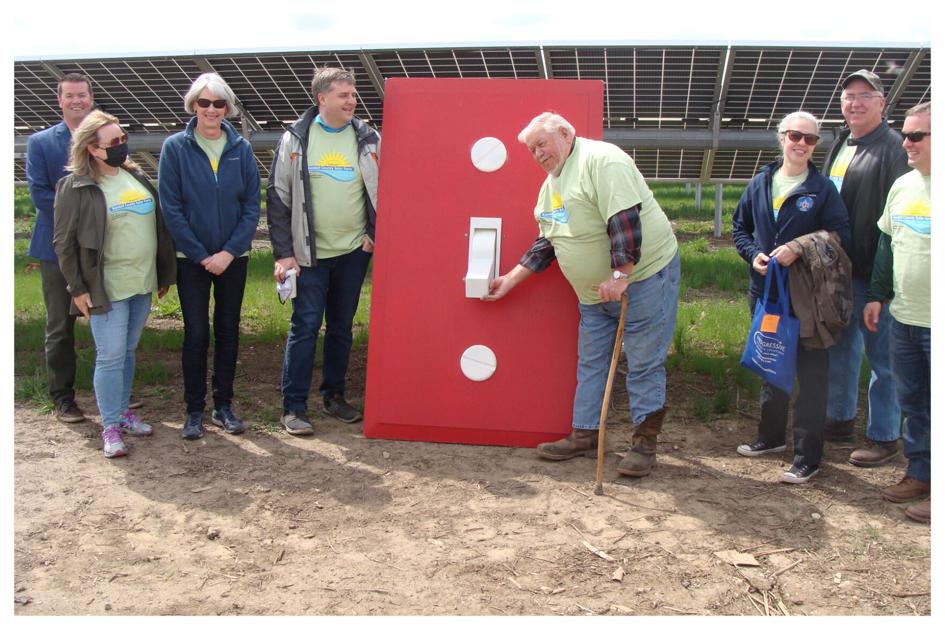
Local officials gathered on Saturday at the solar field west of the Kendall County Public Safety Building in Yorkville for the ribbon-cutting of the county’s solar array.

Progressive Energy of Aurora handled the contracting on the project, and Progressive’s Chris Childress spoke about former county board member Bob “HD” Davidson, who spearheaded the project.

Your browser does not support the audio element.

The solar array will power three buildings on the courthouse campus. Excess power is sent back to Commonwealth Edison for future electricity credits.

There are 5,544 solar modules at the courthouse campus site, and 40 inverters that exchange the direct current to alternating current.

The power from the Kendall County solar field could power 395 homes.

WSPY’s Jim Wyman asked Kendall County Board Chairman Scott Gryder about the cost savings from changing over to solar.

Your browser does not support the audio element.

50th District State Representative Keith Wheeler also attended the ceremony.  The state legislature passed the Future Energy Jobs Act in 2016, which generated the solar activity in Illinois.

Wheeler spoke about the future of solar energy in Illinois.

Your browser does not support the audio element.

No Kendall County tax dollars were used for the project, and the solar field lowered county CO2 emissions by over 50 per cent.

Hear Jim Wyman’s WSPY Radio story by clicking the link below:

Your browser does not support the audio element.

How indigenous land was grabbed for a solar power plant in Assam

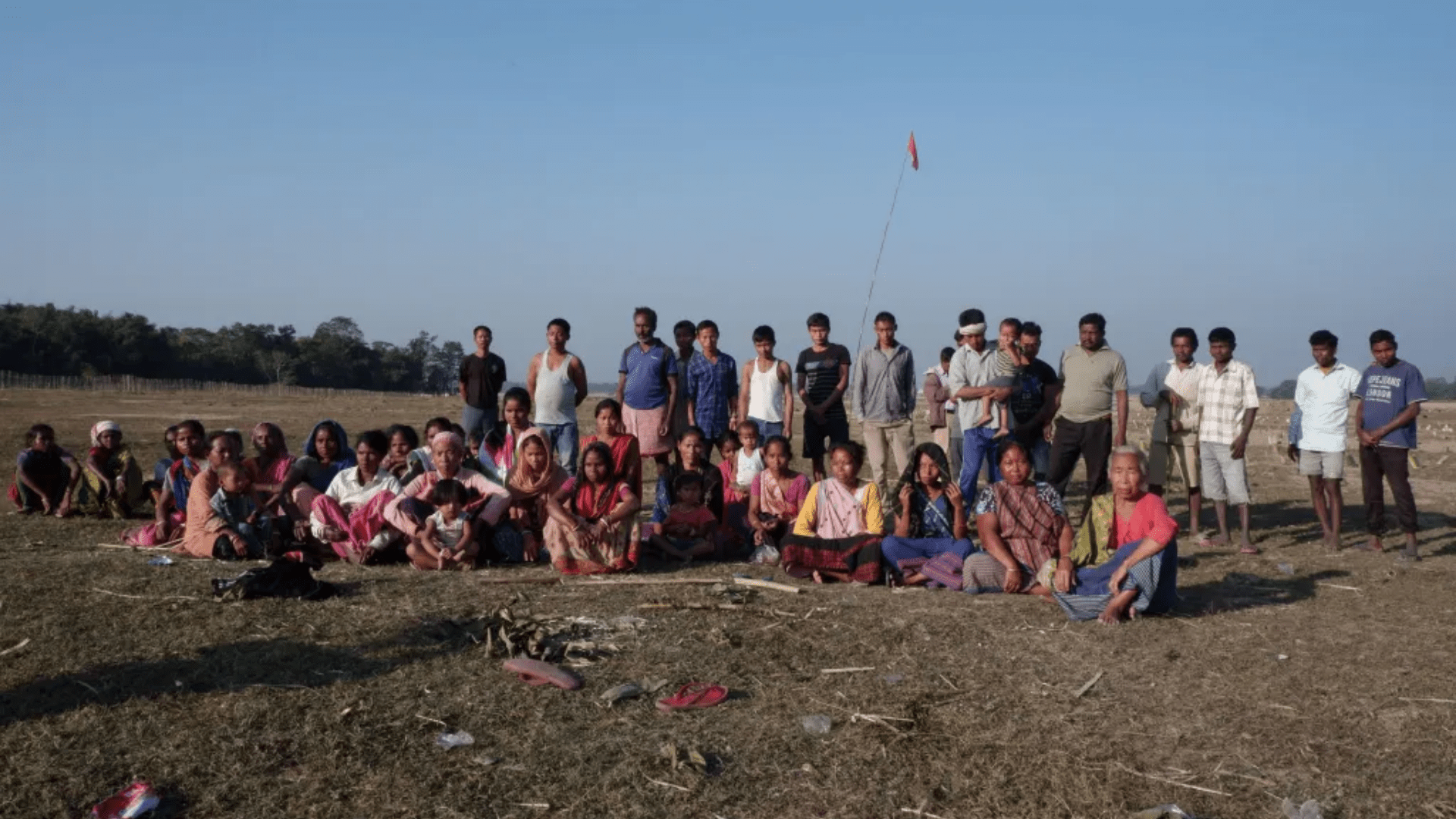
Since March 2020, a struggle has been waged by Karbi and Adivasi farmers of Mikir Bamuni Grant village in Nagaon district of Assam against the forceful takeover of their lands to construct a solar power plant by Azure Power Forty Private Limited. In each formal statement, Azure Power continues to parrot that they are not in violation of the law, as they have legally purchased the land in question on a willing seller-willing buyer basis and are not in contravention of the law.

This, despite several news reports and other interactions pointing out to them that their “willing sellers” did not have the legal right to sell them the land in the first place. The question of land and the system of land rights is central to the story of the conflict in Mikir Bamuni. Delving deeper into this question and a close look at the documents, as well as testimonies of the residents of Mikir Bamuni, this article exposes the web of lies, manipulations and underhanded manoeuvres coordinated between the local administration, landholders and police forces that together orchestrated the theft of peoples’ lands. While stating this, it is equally important to reiterate that this does not absolve Azure Power, a nearly 400-million-dollar company listed on the New York Stock Exchange, of responsibility in the gross violation of the rights of the cultivators. Despite being in the know of the legal provisions of the Assam (Temporarily Settled Areas) Tenancy Act 1971, it appears their legal team has not yet bothered to understand the documents, which, contrary to what they believe, do exist and are in possession of the cultivators. All they had to do was ask. But more on Azure Power later.

Last year, December 29 witnessed the latest round of police aggression against the protesting farmers with one of them, Buku Mardi, allegedly beaten senseless and arrested in the daytime, followed by a midnight raid where police personnel are then said to have forced themselves into the homes of the farmers in the middle of the night, with faces covered, and arrested Sikari Rongpi, Lakhiram Mardi and Bhaity Timung.

To sharpen the protest, the farmers began an indefinite sit-in at the plant site from January 26, demanding the return of their lands and the release of their friends and family members from jail. The 4 arrested spent 63 days in jail and were released on bail only on March 2. Meanwhile, on March 1 the Guwahati High Court ordered status quo on the land in question given the ongoing civil dispute in this matter in the Nagaon district court. Since the order, construction work on the power plant has ceased. This has provided some relief to the protesting farmers and a fresh lease of life to their struggle, that will end only when they win back their lands.

Also read: Darkness under the sun: The struggles of an Assam village against ‘green’ energy

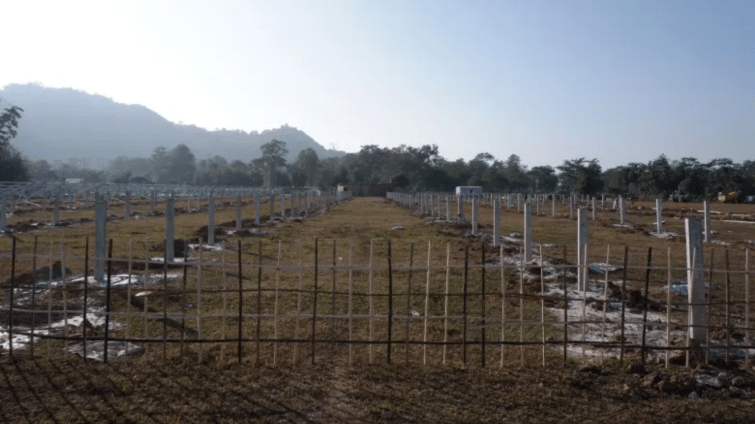
Pillars set by Azure Power to install solar panels

Web of lies I – The adhiar patta

In Mikir Bamuni, the conversion of Fee Simple Grant land, the land tenure under which land was held by the landholders, to Khiraj Miyadi Patta, the only form of land which can be bought and sold in Assam, was central to selling the land to Azure Power. The conversion was made possible by removing the cultivators, who have an entitlement to the land, out of the picture, and placing exclusive rights in the hands of the landholder. This was done through manipulation by making a set of arbitrary and false claims, leading people to believe they had no legal right to the land.

The ease with which such claims were reiterated and spread, inculcating an initial sense of helplessness amongst the residents of Mikir Bamuni, smacks of a casteist arrogance typical of feudal relations likening themselves to kings and rulers, rajas and maharajas, attitudes that have no place in a democratic republic.

Earlier reports have briefly laid out the provisions of the Assam (Temporarily Settled Areas) Tenancy Act 1971 and the inheritable rights it confers upon tenant cultivators who are in continuous possession of the land for 3 years or more. Most cultivators in Mikir Bamuni are in possession of the Rayati Khatiyan, a document that recognises them as occupancy tenants under the Tenancy Act 1971.

Those who are not in possession of the document, claim their forefathers’ names are recorded in the Record-of-Rights as occupancy tenants. The khatiyan dates back to 1981 for all the documents I examined and is in the name of the forefathers (fathers or grandfathers) of those who currently cultivate the land.

The nature of tenant states that they are occupancy tenants, and the period of possession states 33 years, indicating they have been in possession of the land since 1948, as per government records. According to testimonies of the people, their forefathers cleared these lands to make them cultivable in the first instance.

Armed with documents that demonstrate their right of occupancy, they can only be ejected from the land through execution of a decree for ejectment passed by a competent Civil Court “on the ground that he/she has used the land comprised in his/her holding in a manner which renders it unfit for the purpose of tenancy”, i.,e., cultivation (Sec. 51(1) of the Act). Further, Section 54(2) states, “No suit for ejectment of a tenant on the ground mentioned in Section 51(1)…shall be entertained unless the landlord has first served a notice on the tenant requiring him/her to remedy, or to pay compensation for the misuse of the breach complained of and the tenant has failed to comply with it within one month of the receipt of the notice.” In the following sub-section, the Act goes on to further clarify that if the breach or complaint of misuse is remediable the tenant may be directed by the Court to remedy it or pay a reasonable compensation fixed by the Court by a specified date. Only in such case as the tenant still refuses to comply is the ejectment decree to be passed by the Court.

In Mikir Bamuni Grant, no legal notice was served to a single farmer, rendering their ejectment null and void. Instead, a lie began to be circulated such that, despite being in possession of a document that ascertained their right to the land, officials of Azure Power could say, even if in an informal conversation, that the people possessed no documents.

I was told by several people from Mikir Bamuni, including the traditional Gaon Burha or village headman, that the document they had was an ‘adhiar patta’. Adhiar refers to the system of sharecropping in Assam and derives its name from adhi/adha – meaning half – and indicates a system where traditionally half the crop was paid to the landholder for using their land. However, the Assam Adhiars Protection and Regulation Act, 1948 limits this to a maximum of 20 per cent where plough cattle is not provided by the landholder. In either case, despite being in possession of a document whose title is “Rayator Khatiyan”, or khatiyan of rayat (tenant), a distinct legal category from that of an adhiar (sharecropper), they were told they were adhiars and not rayats. Unfamiliar with reading official documents or the law, they were fed this false claim that as adhiars they were to pay half their crop as rent to the landholder, a practice they did not follow and therefore, apparently ceded any rights to the land.

In fact, residents of Mikir Bamuni across those protesting the plant and those in favour of the plant agree that for about 15 to 20 years they have ceased to pay any kind of rent to the landholders. However, as per the law, this does not relinquish their right to occupancy, a myth that was cultivated carefully. Instead, Section 54(3) of the Tenancy Act 1971 mentioned above clearly provides scope to pay the due rent if farmers are willing and retain possession of the land.

The traditional Gaon Burha reiterated this misconception to me, “We only have adhiar patta. And in that system, we have to pay some rent to the zamindar. But since my father’s time, I have never seen any rent given to the landlord. We have not given any chugti, or adhi (types of rent), or khazana (land revenue). So how can we claim any right over the land?” His document was also a rayati khatiyan. On clarifying his rights to him, he expressed both helplessness, now that he had accepted some ‘compensation’ [money], as well as a sense of loss and a search for a better way out. “No one has come and explained these things to us the way you have with clarity. We didn’t know we still have a right to the land. We don’t know the law. When we asked local revenue officers about this matter we were told since we haven’t been paying anything to the landlord, we should come to an agreement with them and settle it between ourselves for the best deal we can get”, he continued.

This is a widely prevalent lie, particularly amongst those who have ‘willingly’ given their lands for the power plant and accepted ‘compensation’ paid by the landlords. This lie has been busted by those who are protesting, and they are the ones who have taken Azure Power, the landholders and state officials to Court in this matter. The very ‘willingness’ of those who have accepted ‘compensation’ based on a fabrication that was fed to them is then put into question.

Web of lies II – Barren land

On 29 February 2020 the Office of the Deputy Commissioner, Nagaon district issued an order approving reclassification of 6 bighas of agricultural land in neighbouring Borlalung Gaon also purchased by Azure Power for the same plant, to industrial class. A similar order of the same date is said to be issued for Mikir Bamuni Grant as well. The order quotes a certificate issued by the Subdivisional Agriculture Officer, Kaliabor which states that “the land in question in not under any agricultural use for the last 10 years and at present the land is not fit for growing any profitable crops” (referring to commercial cash crops including tea).

The same claim is made for Mikir Bamuni. The position of state officials, including the Deputy Commissioner, Nagaon, is that no cultivation has been taking place on the land in question, and it was only in 2020 that people decided to cultivate this land, owing to the entry of the power plant, in a bid to extract some money. Of all the lies that undergird this case, this appears to be the biggest.

Census data shows Mikir Bamuni to be an agrarian village, as are most villages surrounding it. According to the 2011 census, out of a total of 126.6 hectares, 92.5 hectares fell under cultivation, while 26.8 hectares fell under area under non-agricultural uses in Mikir Bamuni Grant village. This would include the school, burial grounds, prayer ground, sports field, etc.

The figure is similar for 2001, indicating continuous cultivation and an agrarian lifestyle. The landscape you are met with while driving towards Mikir Bamuni Grant, which lies at the foothills of the Karbi hills, is typically agrarian, replete with harvested paddy fields.

On speaking to more than twenty families of Mikir Bamuni, across its two hamlets, the Karbi domination Gohain Grant and Adivasi dominated Amdanga, they described in detail their cultivation practices, as well as a range of daily wage and contract work they engage in in order to subsist their families.

Due to lack of irrigation infrastructure, as is the case in most of Assam, the principal paddy crop is cultivated in the Kharif season, along with seasonal vegetable in their kitchen gardens. The varieties of paddy grown include Ranjit, Aijong, Joha, Bora saul, Jeng, Bais muthi and black rice, amongst others. While sowing begins in July, the crop is harvested in December. They spoke of crop loss due to elephants frequenting the area. Labour practices usually involve cultivation on their own fields, along with employing labour from in and around the village itself.

On average, about 4-5 people would be required to work on one bigha of land where wages were about Rs. 130 for women and Rs. 200 for men. For those wanting to be paid in kind, the total amount due is calculated and converted to paddy at the rate of Rs. 500 per maund (40 kgs). Hiring a tractor to plough the land cost Rs. 350 per bigha. All of these details of the cultivation process were narrated by residents of Mikir Bamuni, indicating agrarian households and livelihood practices. However, agriculture alone does not subsist any household, and this is combined by a range of contract and daily wage work, along with animal husbandry.

This included household work in the village, agricultural labour, work in the nearby Hukanjuri Pahar stone quarry, sand mining, driving and work in the nearby tea gardens. This is typical of subsistence cultivation livelihood practices that characterise rural Assam. One would have to be a fool to believe Mikir Bamuni stands as an exception.

Mindful manipulations I – The ‘agreement’

The story so far has gone to say no cultivators were cultivating this land, they have no documents, they may have been cultivating in the past but never paid rent and so their right to the land is relinquished. However, several families of Mikir Bamuni Grant have been paid what has been termed ‘compensation’. To this, even the DC agreed, as is Azure Power fully informed of this, and in much detail in fact. The question that then arises is, why were families paid compensation if they did not cultivate the land and did not possess any right to it?

On 2 June 2019, an agreement was signed between 31 heads of households of Mikir Bamuni and 4 members of the landholder family at a meeting held in the primary and middle school ground in the Gohain Grant hamlet of the village. It was the third or fourth such meeting between the landholders and village residents. The residents were presented with the offer of either buying off their land from the landholders or accepting compensation since the landholders planned to sell any which way. The option of retaining the land, in other words, was absent.

The agreement was written on a white piece of paper and lists out 5 items that were thereby agreed upon – firstly, the landholders would ensure that people’s homestead lands would be converted from adhiar to miyadi patta in their names; that land of the school, sports field, burial ground, and place of worship would be donated to the village by the landholders; that adhiar land to the order of 50 bighas would be compensated at the rate of Rs. 40,000 per bigha; that for 60 bighas of land the value of one year’s crop would be compensated at the rate of 12 maund per bigha at market value (this was set at Rs. 500 from the testimonies of people); and finally, after completion of the 25-year tenure of the solar power plant, if the land would be sold, it must be sold back to the adhiars.

The agreement has no legal basis, extends beyond the mandate or jurisdiction of the parties that signed the paper and is astoundingly arbitrary in a way that is characteristic of feudal attitudes. This agreement is constantly invoked as a testament to the seemingly ‘just’ character of land transfer from the landholders to Azure Power. Azure Power is fully informed of the agreement, although it appears they are in the know of an agreement that has the signature of 74 families, of which 71 ‘accepted’ ‘compensation’, and 3 are fighting in court. This is also at odds with the reality since the names of 3 who did not accept compensation do not match with the people who have filed cases against them in court. The inconsistencies are endless.

Of the twenty families that I spoke with, all of whom have lost or ‘given’ their land to the landholders for sale to Azure Power, about ten received compensation, although of varying amounts. Payment towards ‘compensation’ was done by the landholders, it appears through a broker based in Guwahati, in three instalments – two towards the land and one towards the crop. Moreover, money towards the land was paid for only half the land cultivated by each family.

This was once again based on the false claim that the land was being cultivated under the adhiar system. It is for this reason that the amount was fixed for only 50 bighas of the 270 bighas sold to Azure Power. The residents were told since half the crop was the right of the landholder in the form of rent, by extension they only had right over half the land, and therefore, if a family cultivated 35 bighas of land, they would receive the agreed-upon Rs. 40,000 per bigha for only 17.5 bighas of land!

Azure Power’s repeated parroting of following the law and mandated rules and procedures are meaningless in the face of the blatant fraud involved in granting exclusive miyadi patta to the landholders in the first place, a question the protesting farmers have been raising for months now.

Therefore, while it presents legally sound sale deed papers to demonstrate their lawful possession of the land, the company’s repeated refusal to engage with the protesting farmers despite being made aware of the procedural and legal fallacies in placing this land in the hands of the landholders demonstrates its willful disregard for the rights of the indigenous cultivating farmers. Interestingly, in their formal statement to the press, they reiterate that “the land purchase has been done in a lawful and fair manner, with due consultations with all stakeholders”. If indeed the land was purchased through a private transaction on a willing seller-willing buyer basis, just who are these “stakeholders” and why were they “consulted”? The more Azure Power clarifies the greater number of inconsistencies come to light.

Mindful manipulations II – ‘Compensation’

Sam Ingti, whose families holds the right to 22 bighas, with 15 bighas inside the boundaries of the plant received two instalments, one of Rs. 20,000 towards his land, and another of Rs. 8,000 towards crop loss. Even going by the arbitrary ‘compensation’ rate for half the land as per the agreement, he should have received Rs. 3,00,000 for his land, and Rs. 45,000 for crop loss. Kawe Ingtipi’s family received all in all Rs. 2,000 for crop loss for the 12 bighas of land cultivated by them.

The indignity meted out to cultivators that labour on the land to produce food for their families when such an offensively small sum is paid as ‘compensation’ towards their products cannot be understood. Singh Teron’s family that holds rights to 10 bighas received one instalment towards the land of Rs. 20,000 and Rs. 15,000 for crop loss. Rajen Rongpi whose family lost 10 bighas to the power plant received one instalment of Rs. 20,000 towards crop loss. Babu Timung’s family received all of Rs. 3,500 towards crop loss for the 6 bighas of land his family lost.

Nigom Ingti’s family, for the 2.5 bighas they cultivated within the plant site, received Rs. 2,000 towards crop loss, a cheque they never serviced in refusal of the pittance paid to them. Instead, they have kept the cheque as is as a testament to the paltry sums distributed to them. The figures are arbitrary and nowhere near even the agreed-upon amount, itself a farce. Interestingly, as senior Azure Power officials reached out to me for an informal discussion after publication of a previous article, in order to clarify matters from their end, they insisted that fair compensation had indeed been paid to people.

It was on probing the matter further with them that it came to light that they were not the ones who paid any money to the people, and yet were in a bid to assure me the landholders, through a broker, had paid full and fair compensation to the people. Moreover, many of these instalments were paid by cheque, and are proof of the fact of cultivation. Without cultivation, there is no meaning of compensation. Meanwhile, Azure Power’s repeated press statements that refuse to comment on the grievances of protesting farmers are quite meaningless.

There are several who received no money whatsoever or refused to accept any. While Azure Power officials informed me of 71 households who accepting this so-called ‘compensation’ and are therefore assumed to be in favour of the solar power plant, there are many who received some money but are now opposed to the plant having seen through the manipulations at work in forcing them to part with their land. Several accepted the money based on misinformation and false claims leading them to believe they had no choice but to accept it and give up the land.

Some were asked to sign a stamp paper while accepting the money but were neither told what the paper said, nor given a copy of this paper. The ‘agreements’ and affidavits are closely guarded documents that even the people themselves who are said to have signed do not possess a copy of.

Armed with an understanding that they have an entitlement to the land they are no longer willing to give up their lands to the company. As they began to understand the law and their rights better, they have begun to speak in defence of their land rights demanding the company to leave the area and return their lands.

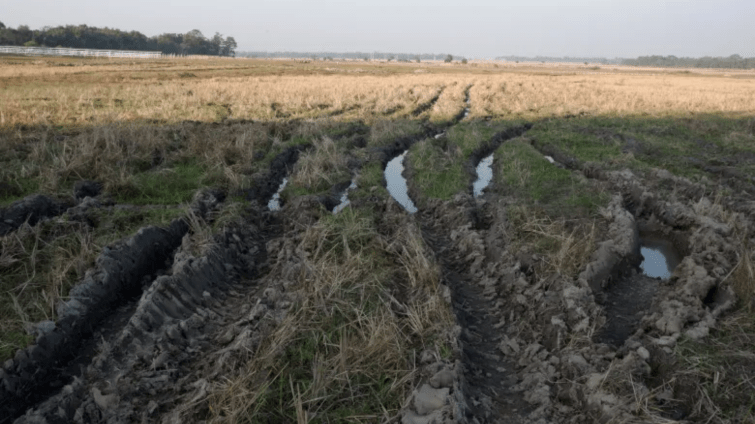
Bulldozers were run over paddy fields damaging ripened crops of the farmers

No rest till the land is returned

What has transpired in the conflict over land in the case of the solar power plant set up by Azure Power Forty Private Limited is trampling on the rights of indigenous tenant cultivators who have legally enshrined rights of occupancy to the land they cultivate, lands that were allegedly cleared and made cultivable by their ancestors and held in possession for more than seven decades.

I met with about fifteen families who held rights to approximately 200 bighas of land within the plant boundary, many of who brought their rayati khatiyan along with them to present proof of their entitlement, all of whom were opposed to giving up their land to the plant. The feudal attitudes of the landholders who actively spread misinformation, manufacturing ‘consent’ to accept ‘compensation’ in place of their land, in connivance with local administration and state officials, combined with the arrogance of Azure Power in claiming legality of the purchase on the basis of “willing seller-willing buyer” demonstrates a class-caste bias that renders certain communities ‘dispensable’.

The flouting of every norm and procedure enshrined in the Assam (Temporarily Settled Areas) Tenancy Act 1971 and a refusal to engage with its provisions smacks of an arrogance that casually runs roughshod over hard-won rights of the labouring masses who work the land.

A disconnect with the ground realities of rural India is brought out sharply by the attempt of Azure Power at winning over the “local community” when it distributed piglets principally to the Karbis of Mikir Bamuni Grant in the midst of the spread of African Swine Fever in Assam, leading most of the animals to die within a few days of distribution.

On one hand, the state-landlord-corporate nexus has come together to negate the very existence of the cultivators when they claim the land was not under cultivation. On the other, the parallel and contradicting narrative of an ‘agreement’ towards ‘compensation’, a tacit recognition of continuous cultivation, is rife with manipulation and violation of the law put in place to govern such agrarian arrangements. While much of the violations have been committed by the landholders and local state officials in connivance with a few key community members, Azure Power bears the moral responsibility for its impacts since all violations were committed in order to sell the land to the company for setting up their solar power plant, violations they are well aware of.

Meanwhile, the farmers are not prepared to rest until the land is returned to them, so that they may once again labour on the land to feed their families and loved ones.

Vasundhara Jairath is Assistant Professor in Development Studies at IIT Guwahati. This article was first published in countercurrents.org and can be read here. Opinions are personal.

Related

Maine lawmakers taking closer look at solar power payback

AUGUSTA — Consumers interested in rooftop or community solar should stay tuned to what comes out of the Maine Legislature by the time members adjourn in June.

At issue is something called net energy billing, which in simple terms means when a home’s or business’s rooftop solar panels generate more electricity than needed onsite and the home or business owner gets credit for that electricity, which gets fed into the New England power grid.

For instance, a home with 22 solar panels may generate 906 kilowatts in June but only use 153 kilowatts that month; the extra 753 kilowatts go to the grid and the consumer gets a credit that’s applied when the consumer’s electrical demands are greater than the solar panels can produce, often in the winter.

How net energy billing is handled by each state impacts how much a residential rooftop or community solar customer receives for generating electricity.

After Gov. Janet Mills came into office, changes to net energy billing made solar investment more inviting in Maine. Solar is growing, especially large commercial projects with hundreds and hundreds of panels.

In the Maine Legislature, some Republicans are concerned the state’s current net energy billing level is too generous to solar panel owners, especially to huge solar projects. They fear that the amount of money utility companies have to pay solar panel owners for their electricity is too high, and the additional cost in the long run will be passed onto all ratepayers.

Democrats say that fear is overblown, and that more solar energy is needed to offset climate change and meet renewable energy goals.

But both sides say net energy billing should be looked at.

“For those of us who have rooftop solar, or a share or subscription to a community solar array, majority Democrats on my committee intend to make no changes,” said Rep. Seth Berry, D-Bowdoinham, co-chair of the Legislature’s Committee on Energy and Utilities.

Berry has proposed a brief moratorium (LD 709) on new, large 2 to 5 megawatt solar projects that would have acres and acres of solar panels.

“Any changes would only be made to very large arrays typically covering many acres, to ensure that the state continues to encourage a robust, competitive market that keeps costs down while encouraging more renewables,” he said.

A couple of bills from Rep. Jeff Hanley, R-Pittston, and Sen. Trey Stewart, R-Presque Isle, “proposed to roll things back dramatically,” Berry said, and those could impact rooftop or community solar.

Hanley acknowledged last week that with Democrats in the majority in the Legislature and with a Democratic governor, “I do not expect these to pass.”

The committee has a subcommittee that just started meeting this week to recommend what changes should be made, Stewart said Thursday.

“We’re hearing from interested parties, PUC (Public Utilities Commission), the Governor’s Energy Office, individual ratepayers, the utilities, the solar companies. That’s going on right now.”

Stewart acknowledged there’s no support for one of his bills, LD 249, which calls for doing away with net energy billing entirely. But, he said, changes are needed.

Additionally Maine’s power grid is not set up to handle the huge amounts of energy coming from the hundreds of proposed solar projects in Maine, critics say, which means substantial upgrades would be needed.

Stewart said he’s not opposed to solar. “Maine has set a goal of what we want our energy to be, where we want it to come from. That’s important. I do think we should be cognizant of our impact on the environment and climate.”

But he said it doesn’t make sense to allow solar companies based out of Chicago and elsewhere to make profits for shareholders at the expense of ratepayers.

When asked if someone planning rooftop solar or joining a community solar program should hold off pending the outcome of net energy billing legislation, Stewart said, “that’s a good question.” He then said rooftop solar is not the problem, that a resident considering it should “carry on. You’re in good shape.”

Dan Burgess, director of the Governor’s Energy Office, said Thursday he can’t speculate on the outcome of any legislation. “What I can say is that our office is committed to working with the Energy and Utilities Committee and stakeholders on this issue.”

Solar in all forms is an important part of Maine’s clean energy mix, Burgess said in an email. “It is helping reduce our dependence on fossil fuels to fight climate change and has generated millions (of dollars) in new investments into the state in just two years.”

With that progress comes the need to review policies, he said, to ensure the state is advancing a “solar market that appropriately balances investments” with the benefits of solar projects.

To learn more about community solar, which allows renters, homeowners and businesses alike to sign contracts with commercial solar projects with the intention of investing in cleaner energy and possibly lowering electric bills — without having to invest in their own solar panels — visit the Maine Public Advocate’s website at www.maine.gov/meopa/electricity/community_solar


Invalid username/password.

Please check your email to confirm and complete your registration.

Use the form below to reset your password. When you’ve submitted your account email, we will send an email with a reset code.


« Previous

Migraine sufferers unite!


Next »

$13 a month for heat and electricity. A tale of two solar converts

Related Stories

Loading Related Posts

From atomic bomb to solar power, Downers Grove scientist always innovates

By Burt Constable

Dieter Gruen escaped Nazi Germany, worked on the Manhattan Project during World War II, helped design nuclear submarines, earned patents throughout a celebrated and innovative career at Argonne Laboratory, and is still working on a more efficient form of solar energy at age 98.

That’s why U.S. Rep. Sean Casten is nominating his fellow Downers Grove resident for the Presidential Medal of Freedom.

“Dr. Gruen is a renowned scientist and fierce advocate for climate action whose contributions over eight decades have transformed American technological development, from nuclear fission and fusion to solar and energy storage. We as a nation are forever in his debt,” says Casten, a Democrat who drafted a letter to President Joe Biden with fellow Reps. Bill Foster, a Naperville Democrat; Arkansan Republican French Hill; Cheri Bustos, a Democrat from East Moline; and California Democrat Jerry McNerney.

Gruen came to the United States from Germany in 1937 as a 14-year-old.

“I left for the reason I could no longer go to school. It was very difficult because of my religion,” Gruen says, explaining how his Judaism made him a target in his hometown of Meiningen in 1930s Germany. “I could go, but they would beat me up after school, the Hitlerjugend or Hitler Youth.”

His father, Joseph, a principal at a school, and his mother, Meta, arranged for him to live with relatives in the United States.

“At that time it was possible to leave Germany if you had a visa,” Gruen says. He sailed to New York on the White Star Line’s HMS Georgic with his brother, Herbert, who was eight years older and had been going to school in England. He lived with an uncle and aunt in Little Rock, Arkansas, where he was part of a sizable Jewish community. He learned to speak English fluently without an accent and excelled in school.

He graduated from Little Rock Central High School, which later became the civil rights epicenter of the Brown v. Board of Education Supreme Court decision that integrated schools.


“I took chemistry in high school in Little Rock and that’s where I really became interested,” Gruen says.

In 1939, his parents were sent to a Nazi concentration camp in Buchenwald, where they were given 24 hours to leave the country and managed to make it to relatives in Luxembourg “about six months before the war began,” Gruen says. He reunited with them after they came to Chicago. Gruen would take the “L” from their apartment in the Uptown neighborhood to Evanston to attend classes at Northwestern University.

“I used to have lunch on the shore,” Gruen remembers. “There were rocks there, and I’d eat the sandwich my mother had prepared for me and dangle my feet in the water.”

Excelling in his major of chemistry, Gruen was selected to serve his nation. “I was recruited to work on the Manhattan Project, so I went to Oak Ridge, Tennessee, and worked there until April of 1946,” he says. Uranium largely consists of two isotopes, U-235 and U-238, and Gruen created a new material that enabled scientists to extract the U-235 used to make the nuclear bomb that was dropped on Hiroshima.

“After the bomb was dropped, quite a few of the people got together and recognized this should not happen again,” says Gruen, who helped form the Oak Ridge Scientists and Engineers group determined “to prevent another nuclear device being used again.” Their work led to the Atomic Energy Act of 1946, which regulated how the new nuclear energy would be used.


After the war, Gruen got his doctoral degree in chemical physics from the University of Chicago, where he worked on the magnetic properties of the newly synthesized element neptunium and helped determine its place in the periodic table.

He was hired by Argonne National Laboratory in 1947 and developed a method of “protecting the uranium fuel from corrosion” in nuclear submarines.

Working in a lab at the Foote Mineral Co., Gruen earned a patent in 1949 for his method of using distillation to separate the elements of zirconium and hafnium, which is used in control rods of nuclear submarines. Gruen experimented with elements essential to nuclear reactors and then cardiac pacemakers, and his work with transuranic elements led to the category 5F in the Periodic Table.

“He’s been able to move from one field to another,” says Larry A. Curtiss, an Argonne distinguished fellow and senior group leader who did research and collaborated with Gruen during their careers. Gruen’s inventions have made nuclear power safer, improved medical devices and advanced alternative energy solutions. Gruen has never slowed down.

“He discovered (a nanocrystalline diamond film used in biomedical applications) at 70, when most people have retired,” Curtiss says.

At Argonne, Gruen has served as senior scientist and group leader, as well as associate director of the Materials Science Division. He was named an Argonne distinguished fellow, emeritus, in 2012.

He currently is working on designing more efficient solar energy panels using graphene, a structurally different form of carbon.

“I have a prototype. What I need are investors,” says Gruen, who went to Boston last week to discuss his research. He did much of that research at the University of Illinois in Chicago.

“The sunlight is pure energy,” Gruen says. “We get enough energy in sunlight in one hour for the energy needs of all 7 billion people for a year.”

Reps. Casten and Foster share a science background with Gruen and have become friends.

“I’ve spent several afternoons in his backyard,” Casten says of Gruen. They talk about solar power, climate change and new forms of energy.

Gruen met his wife, Dolores, while they were graduate students at the University of Chicago. “We had a very happy and fulfilling marriage,” says Gruen, who was married 66 years when his wife died in 2015. She was a pioneering school psychologist and psychotherapist. They had two daughters — Erica, an Emmy-winning producer who became president/CEO of The Food Network, and Karen, who is a psychologist and consultant — and a son, Jeffery, a physician who founded an innovative health care company.

“I feel very, very honored,” Gruen says of his nomination to receive a Presidential Medal of Freedom. Casten nominated him last year and took Gruen as his guest to the State of the Union in February 2020, when there was a medal presentation made to Rush Limbaugh.

“I was just a few feet away when he received the medal,” Gruen says of the ceremony when first lady Melania Trump hung the Presidential Medal of Freedom around the neck of the radio personality. “I really don’t expect to get it this time, but it’s nice to be nominated.”

Casten says Gruen’s accomplishments merit the award, but his story as an immigrant who persevered is equally inspiring.

“He is just so filled with hope,” Casten says, noting Gruen never gave up hope when he was getting beaten up by Hitler Youth, when his parents were in a concentration camp, or when nuclear war and now climate change threaten our planet. “He didn’t lose faith. It’s the American spirit at its best.”


Solar developers pitch for additional 3 months extension in commissioning date

New Delhi: With the second wave of the coronavirus pandemic spreading across the country, solar industry lobby group Solar Power Developers Association (SPDA) has requested for an additional three-month extension in the project commissioning date to the ministry of new and renewable energy (MNRE).

This is in addition to the five months extension granted by MNRE. Power purchase agreements signed by developers specify strict commissioning deadlines and a failure to meet them can result in fines and encashment of their bank guarantees.

“Govt. had taken the problems into cognizance and provided relief in blanket extension for five months through an O.M. dated August 13, 2020. The extension was granted basis assumption there will be normalization in equipment supply, logistics, labour supply, the functioning of Government offices, etc,” SPDA said in a statement on Saturday.

“The second wave of the COVID‐19 pandemic has been advancing swiftly, with a big spike registered across Maharashtra, Karnataka, Tamil Nadu, Madhya Pradesh, Uttar Pradesh, Punjab, Rajasthan, etc. To arrest the virus’s spread, various State Government and local administration have announced vaccination drive and local restrictions affecting the movement of personnel, labour, and delay on multiple approvals from State authorities, etc. Due to the second outbreak, solar power developers are witnessing scarcity of workforce at sites again, putting the project construction to hold again,” the statement added.

According to the ministry of health and family welfare, a total of 1,341 deaths were reported in the last 24 hours, with ten states accounting for 85.83% of the new deaths.

“Besides, interventions made by Govt. to resurrect the economy are indeed worth commending. SPDA wishes to highlight the continued challenges that the Solar Power Industry faces for the last year, which have become even more acute with time. Many solar projects are coming up in the states of Rajasthan and Gujarat. Due to the peak summer season, project construction activities are generally carried out in the late afternoon and end in the evening. Some firms are also night shifts to catch up with the project schedule. However, due to the Second Wave of COVID‐19, the District administration has imposed night curfew at many places,” the statement said.

With India having strict project commissioning deadlines, a failure to meet them will result in penalties for developers.

“Since projects are located at locations far‐off from the workers’ dwelling places, project activities must close by 5 pm. It is again hampering the speed of construction. There is a general apprehension that if the situation continues like this, there can be a significant delay in commissioning the projects,” the statement added.

India is running the world’s largest clean energy programme to achieve 175 gigawatts (GW) of renewable capacity, including 100GW of solar power by 2022. According to the Central Electricity Authority, by 2030, the country’s power requirement would be 817GW, more than half of which would be clean energy, and 280GW would be from solar energy alone. To achieve the target of 280GW, around 25GW of solar energy capacity is needed to be installed every year till 2030.

Subscribe to Mint Newsletters

* Enter a valid email

* Thank you for subscribing to our newsletter.

Adani Green Energy wins 150 MWac solar power project


Adani Renewable Energy Holding Fifteen (AREHFifteenL), a wholly owned subsidiary of Adani Green Energy (AGEL) participated in a Tender issued by Torrent Power for procurement of power through competitive bidding process, from grid connected solar photovoltaic power projects to be setup in Gujarat.

AREHFifteenL has been awarded a project capacity of 150 MWac Solar Power Project.

The fixed tariff for this project capacity is Rs. 2.22/ kWh for a period of 25 years.


The Project is expected to be commissioned by Q3 FY2023.

Currently 3,520 MWac of renewable energy projects are operational. With this, AGEL now has a total portfolio 15,390 MWac of renewable energy project capacity, out of which 11,870 MWac projects are under implementation.

Powered by Capital Market – Live News

(This story has not been edited by Business Standard staff and is auto-generated from a syndicated feed.)

Dear Reader,

Business Standard has always strived hard to provide up-to-date information and commentary on developments that are of interest to you and have wider political and economic implications for the country and the world. Your encouragement and constant feedback on how to improve our offering have only made our resolve and commitment to these ideals stronger. Even during these difficult times arising out of Covid-19, we continue to remain committed to keeping you informed and updated with credible news, authoritative views and incisive commentary on topical issues of relevance.

We, however, have a request.

As we battle the economic impact of the pandemic, we need your support even more, so that we can continue to offer you more quality content. Our subscription model has seen an encouraging response from many of you, who have subscribed to our online content. More subscription to our online content can only help us achieve the goals of offering you even better and more relevant content. We believe in free, fair and credible journalism. Your support through more subscriptions can help us practise the journalism to which we are committed.

Support quality journalism and subscribe to Business Standard.

Digital Editor

Solar panels to be installed at Calgary’s Chinook Centre

CALGARY —
Electricity generation in Calgary will be a bit greener this summer thanks to an innovative project at the city’s largest shopping centre.

ENMAX Power and Cadillac Fairview Chinook Centre have agreed on a plan to install a number of solar panels on the roof of the mall to enable two-way flow onto a specialized secondary network.

The pilot program is expected to solve an important issue that affects electricity grids throughout North America.

“This innovative solution will help remove technical and financial barriers to distributed generation, giving residential and commercial customers in urban settings more choice in how they generate and use electricity while building resiliency of the grid,” ENMAX wrote in a release.

Meanwhile, the Canadian government says renewable energy sources, such as solar power, are “a huge economic opportunity” for Alberta as well as communities across the country.

“Canadians have the ingenuity, determination and work ethic to seize this opportunity and build a low-emissions energy future that gets us to net zero,” said Natural Resources Minister Seamus O’Regan in a release.

ENMAX says it is the first utility company in Canada to come up with a solution to the “complex technical challenge.”

The installation will take place during the summer and ENMAX will collect data about the system once it is connected in order to perfect the technology before it can be introduced to other customers.

  • « Go to Previous Page
  • Go to page 1
  • Interim pages omitted …
  • Go to page 55
  • Go to page 56
  • Go to page 57
  • Go to page 58
  • Go to page 59
  • Interim pages omitted …
  • Go to page 75
  • Go to Next Page »

Primary Sidebar

technology newsroom

Helping Retail Agents

Retailers are under increasing … [Read More...] about Helping Retail Agents

Turning Customers into Advocates

How do you transform satisfied … [Read More...] about Turning Customers into Advocates

Your Employees Are Your Greatest Asset

I have always fostered this … [Read More...] about Your Employees Are Your Greatest Asset

Ensuring Reliable AI Applications

Harnessing the latest AI tools … [Read More...] about Ensuring Reliable AI Applications

Ferrying Excellent Customer Service

Transportation providers have one … [Read More...] about Ferrying Excellent Customer Service

Footer

technology newsroom
  • Privacy
  • Terms

TECHNOLOGY NEWSROOM

123 Main Street, Suite 500 Anytown, USA 12345 Email: info@technologynewsroom.com

Copyright © 2025 · Technology Newsroom

  • Privacy
  • Terms