For decades, contact centers have lived with a frustrating paradox: despite better training, routing, and knowledge systems, first contact resolution (FCR) has barely improved. In many organizations, it has even declined.
Customers describe their issues in detail, agents follow every troubleshooting step, and yet something is still missing. Customers call back, escalations rise, and support costs quietly grow.
The reason is simple. Most AI and support tools only understand one dimension of the customer’s problem, while real-world issues are multidimensional.
To illustrate, a customer may:
- Describe an error, but the real clue is hidden in a screenshot.
- Read out a code, but the root cause becomes obvious only when the agent sees a device’s blinking pattern.
- Insist a feature is not working, but the screenshot reveals a configuration mismatch.
Voice alone is no longer enough. Text alone is no longer enough. To solve modern problems on the first attempt, contact centers need AI that can understand what customers say, what they show, and what they experience.
By merging visual and contextual clues with language understanding, multimodal AI eliminates the ambiguity that causes repeat contacts.
This is where multimodal AI becomes the missing critical pathway in modern FCR, supplying it with fresh oxygen. It gives agents the same visual and contextual cues customers rely on when they experience issues.
Traditional AI Has Hit Its Limits
Most contact centers have already invested in AI. Speech analytics, sentiment detection, auto-summaries, and knowledge recommendations are common.
But these systems nearly all share the same hidden limitation: they rely almost entirely on text. Speech becomes text. Chats remain text. Ticket notes become text.
But customers do not experience problems in text. They experience problems in screens, devices, apps, error lights, misconfigurations, environmental factors, and network behavior.
A customer can spend 10 minutes describing what a single picture could clarify instantly. This is why so many calls end with the same sentence: “I just need more information.”
This line is the death of FCR. It is where customers fall through the cracks. Not because agents are unskilled, but because their tools are not designed to capture the true context of the issues.
What is Multimodal AI And Why It Helps
Multimodal AI is a new class of systems that can understand and combine multiple types of input at once. In the contact center, this includes voice, chat, images, screenshots, video, device logs, telemetry, and contextual signals.
…the true pinnacle of successful customer service and support, enabled by agentic AI, is when the customer doesn’t need to reach out at all.
Instead of forcing the customer to translate visual information into words, multimodal AI can see the issue directly. Examples in a contact center workflow include:
- A customer uploads a photo of a router, and AI identifies the model, status lights, and likely errors.
- The customer shows an app screen, and AI recognizes missing permissions or misconfigurations.
- AI reviews a short video and detects unusual device sounds or operating patterns.
- The customer verbally explains the issue, and AI correlates the voice description with visuals and logs.
By merging visual and contextual clues with language understanding, multimodal AI eliminates the ambiguity that causes repeat contacts. And, as I will discuss later in this article, it also sets the stage for the next major evolution in customer service: agentic AI systems.
How Multimodal AI Revives FCR
Multimodal AI breathes new life into FCR by breaking the expensive cycle of incomplete information. When an agent relies solely on a verbal description, they often troubleshoot the symptom(s) described by the customer rather than the root cause visible only to the eye.
This creates a cascade of failure; the agent applies the wrong fix based on a guess, the issue persists, the customer calls back, and the cost per resolution doubles.
Multimodal AI mitigates this efficiency loss through three foundational mechanisms.
1. Eliminates guesswork from troubleshooting. Most repeat contacts occur because the initial call lacked the right context.
If an agent cannot see the problem, they are forced to rely on the customer’s interpretation. If that interpretation is wrong, the troubleshooting is wrong.
For example, a visual clue that is impossible to describe clearly – like a specific artifact on a screen or a frayed cable – becomes immediately recognizable when AI processes an image or video.
This precise diagnosis ensures the correct fix is applied the first time, preventing the “bounce back” effect that drives up support costs in:
- Hardware troubleshooting.
- Application configuration.
- Connectivity issues.
- Device setup workflows.
- Subscription or account mismatches.
Industry analyses of multimodal visual support deployments indicate reductions in repeat contacts, with reported FCR improvements averaging around 22% in select workflows.
2. Gives AI and human agents full pictures before they act. Agents perform complex work while juggling multiple tools and rapidly changing customer explanations.
- What AI agents do: Analyze visuals and logs, extract key signals, summarize findings in plain language, and detect known patterns to recommend likely fixes.
- What human agents do: Interpret the findings, apply judgment, empathy, and decision-making, confirm the path forward, and manage the customer relationship.
This partnership shortens resolution time and increases accuracy.
3. Reduces unnecessary technician dispatches. Many field visits, or “truck rolls,” happen because the contact center did not have enough information to confidently confirm the root cause remotely.
This is one of the highest costs a service business can incur. Direct operational costs range from $200 to $500. But the Technology & Services Industry Association (TSIA) reports that the true cost when factoring in vehicle depreciation, labor burden, and opportunity costs can exceed $1,000 per incident.
Multimodal AI strengthens that decision point. Here’s how.
- AI agents: Analyzes visual evidence, matches error states to known failures, validates environment or configuration issues, and predicts whether a field visit is truly required.
- Human agents: Makes the final determination, communicates next steps to the customer, and manages expectations.
Across industries, organizations using multimodal visual AI report an average of 19% reductions in avoidable technician dispatches, driven by more accurate remote diagnosis and better dispatch decisioning.
The SEE-SAY-SOLVE Framework
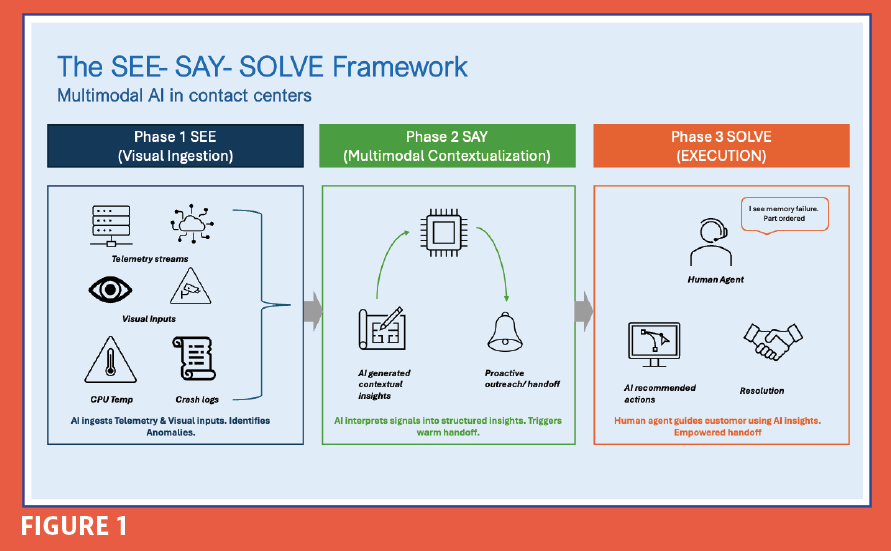
In this article I want to introduce the SEE–SAY–SOLVE methodology (see FIGURE 1), an original operational model for applying multimodal AI in contact center environments to improve resolution accuracy and FCR across enterprise contact centers.
- Phase 1 (SEE) visual ingestion: The AI ingests telemetry and visual inputs.
- Phase 2 (SAY) multimodal contextualization: The system interprets visual signals into structured text.
- Phase 3 (SOLVE) execution: The human agent uses these insights to guide the customer, supported by AI-recommended actions.
This model preserves human leadership and judgment while providing AI-powered clarity.
Telemetry-Based Proactive Support
While the interactions above describe a customer reaching out to us, the true pinnacle of successful customer service and support, enabled by agentic AI, is when the customer doesn’t need to reach out at all.
By integrating device and system telemetry into the SEE-SAY-SOLVE methodology, we can move from reactive ticket-handling to proactive problem-solving that connects machine detection directly to human resolution.
- SEE (The silent signal): Instead of waiting for a customer to report a “slow laptop” or “network error,” AI agents continuously monitor telemetry streams (e.g., CPU temperatures, application crash logs, battery health cycles).
- The AI “sees” the anomaly the moment it deviates from the baseline, often identifying that a hard drive is failing days before the user loses data.
- SAY (pre-emptive outreach): Once the signal is caught, the AI triggers a proactive communication flow.
If the issue is critical, the AI prepares a warm handoff summary, translating raw telemetry codes into plain English context. It doesn’t just say “Error 404”; it tells the system, “The user’s primary application has failed three times in the last hour.”
- SOLVE (The empowered handoff): This is where the connection to the human agent becomes vital. When the customer engages – perhaps via a callback triggered by the AI – they are never asked, “What seems to be the problem?”
- That’s because the human agent already has the diagnostic data on their screen. They can immediately say, “I see your device flagged a memory failure this morning. I’ve already ordered the part for you.”
This seamless thread from the silent telemetry signal to the AI’s alert and finally to the human agent’s resolution of the issue transforms support from a cost center into a trust-building engine.
For the first time, we have AI that can understand customers the way humans do: through sight, sound, and context.
Industry analysis confirms the value of this shift. McKinsey reports that AI-driven proactive engagement and communication can reduce cost-to-serve by 20% to 30% while simultaneously boosting revenue by 5% to 8%.
Where Multimodal AI Fits In
Multimodal capability integrates smoothly with existing layers in the contact center.
- Self-service and virtual assistants: AI handles intake, visual understanding, and simple resolutions.
- Agent assist: AI provides real-time context and guidance to agents.
- Post-call summaries: AI documents both visual and verbal root causes.
- Proactive support with telemetry: As described earlier, AI detects early warning signs, interprets signals, and gives agents the ability to resolve issues before customers experience failure. Thus moving operations from reactive to preventative.
Four Practical Steps to Start
- Pinpoint high repeat contact categories: Focus on issues where agents repeatedly ask what the customer is seeing.
- Enable image or screenshot intake: This forms the foundation for multimodal understanding.
- Train agents on AI-generated insights: Agents remain the decision-makers. AI enhances clarity.
- Start with one journey: A single high-impact workflow builds momentum and proves value.
The Future: Agentic Multimodal Systems
Agentic systems, with multimodal AI, are the next level of service and support and FCR. These do not just perceive and summarize problems. They can take safe, reversible actions that shorten time to resolution and reduce operational load.
This shift is accelerating rapidly; Gartner predicts that by 2028, 33% of enterprise software applications will include agentic AI, up from less than 1% in 2024.
Here’s how to clearly differentiate the roles played by AI and by people.
What future AI agents will do:
- Interpret visuals, logs, and telemetry automatically.
- Run guided diagnostics without human intervention.
- Validate device states or configurations.
- Trigger safe workflows such as resets or permission checks.
- Resolve simple issues independently.
- Prepare full context packages for human agents on complex problems.
These capabilities will allow entire categories of low-complexity contacts to become fully autonomous, improving speed and reducing cost.
What human agents will focus on:
- Complex, emotionally sensitive, or high-consequence issues.
- Situations with multiple variables or unclear signals.
- Customer reassurance, negotiation, and expectation setting.
- Oversight and approval for agentic workflows.
- Relationship building and brand experience.
- Final decision-making in ambiguous cases.
This division of labor results in a high-efficiency model. Where simple, mid-complexity issues are resolved autonomously by AI, and complex interactions are solved through AI plus human collaboration, not by human effort alone.
Agentic multimodal systems represent a natural continuation of the SEE-SAY-SOLVE model. Once AI can see and explain, the next logical step is allowing it to take carefully defined actions.
This is not speculation. The earliest forms of these systems are already emerging across advanced support operations.
Conclusion
For years, contact centers have attempted to improve FCR through better routing, training, and knowledge systems.
But the real barrier was not agent capability. Instead it was a lack of information and a lack of context.
Customers experience problems visually. Agents troubleshoot verbally. Traditional AI sits in the middle and fails to connect the two worlds.
Multimodal AI finally bridges this gap, providing that missing link. It replaces heuristic assumptions with deterministic data, gives agents the full picture instead of partial information, and enables resolution on the first attempt instead of repeated frustration.
And by doing so, multimodal AI becomes the foundation for the next frontier: agentic systems that autonomously resolve simple issues, while empowering agents to solve complex ones with more speed, more confidence, and more context than ever before.
For the first time, we have AI that can understand customers the way humans do: through sight, sound, and context. That is why multimodal AI is not just the future of FCR. It is the beginning of a fully agentic support ecosystem.