Every customer has felt it. You log into a portal, try to find an answer, and get caught in a maze of automated menus, chatbot responses, and dead-end links. After a few failed attempts, the only solution is to call customer service. By the time a human answers, patience is thin and frustration is high.
That cycle of rising effort and falling satisfaction – resulting in customer friction – is now a defining feature of modern customer experience (CX). The 2025 Liferay Digital Self-Service Report reveals how deep this frustration runs.
- 68% of consumers have abandoned a digital task.
- 73% have skipped a purchase because the process was too annoying.
- 82% said they feel they are doing work that company employees once handled.
These numbers demonstrate that customers are working harder than they should to get basic things done.
This shift carries consequences that extend beyond individual interactions. When people feel they are performing labor for a brand, they lose trust. When their frustration reaches the contact center, it affects both customer relationships and the wellbeing of frontline employees.
This article explores the hidden costs of customer effort and the human toll it takes on service teams. But it also examines the opportunity organizations have to restore balance through better design, smarter orchestration, and renewed empathy.
The Cost of Effort
Customer self-service was built on the simple idea that you can give people the tools to solve their own problems quickly and conveniently.
The promise was efficiency for both sides. But over time, it has eroded. The Liferay survey found that 64% of respondents feel frustrated during digital self-service experiences, and 39% feel exhausted afterward (see CHART 1).
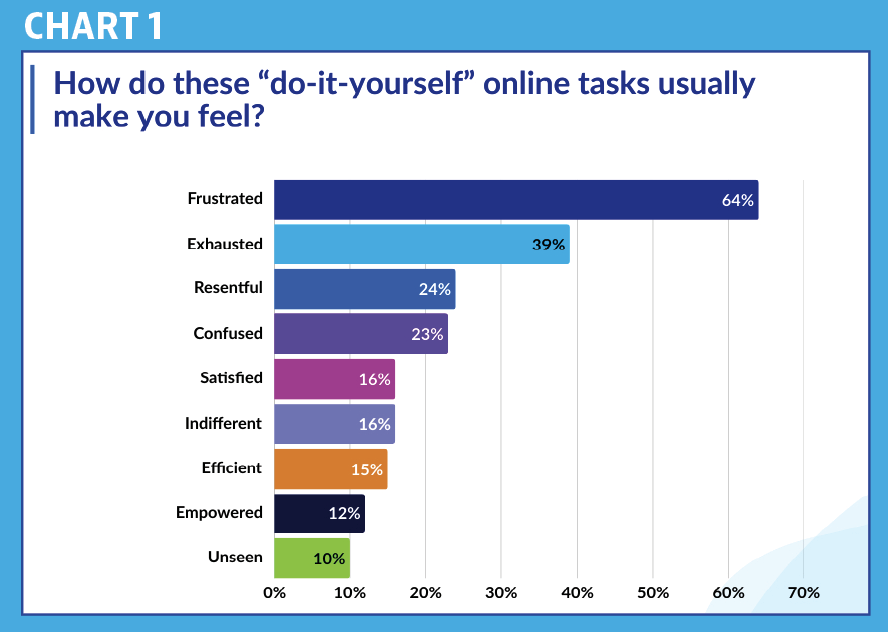
When customers sense that a company’s systems are designed for internal convenience rather than user success, patience disappears.
The result is dissatisfaction and emotional fatigue. A digital form that rejects an address, a chatbot that loops the same questions, or a portal that times out before completion sends the message that the customer’s time is less valuable than the company’s.
Each of these moments has a measurable impact.
- Every restart or re-entry increases abandonment rates.
- Every failed self-service attempt pushes volume to the contact center, often at higher intensity.
According to the report, 91% of users have had to restart a digital task after an error. That number represents lost time, lost trust, and increased strain across the organization.
When Customers Become Unpaid Staff
One of the most striking findings in the Liferay report is that 82% of respondents feel they are performing tasks that employees once handled. This sentiment signals a major disconnect in how companies view self-service.
Customers now routinely fill out data forms that replicate what agents once entered. They search for solutions that once came from support staff. They even manage workflows, such as submitting, verifying, and tracking claims or orders, which used to occur behind the scenes.
These activities are framed by companies as empowerment. But they often feel like unpaid labor.
When that labor fails to deliver results, frustration builds quickly. For contact center agents, this has direct consequences. Agents report facing more emotional customers than ever, many of whom are already fatigued by digital systems before they even make a call.
Automation should simplify, not shift complexity onto the users.
In CX strategy, this is known as the effort paradox. As organizations invest in automation, customers feel less supported. They encounter more steps, more screens, and less empathy.
This tension undermines brand loyalty, placing revenues at risk. It also puts additional emotional pressure on the employees who serve as the final human touchpoint, which I am going to discuss in the next section.
The Agent Experience Connection
The consequence of this effort paradox is most directly felt by the employees who are tasked with being the final point of human contact.
Contact center agents often absorb the emotional residue of poor design decisions. So, when self-service tools fail, they become the safety net for every broken digital interaction.
By the time customers reach the agents, they are already drained. These employees then spend time apologizing for systems they did not create, shouldering frustration they cannot resolve alone.
This dynamic has a cost. Emotional exhaustion is one of the leading contributors to agent attrition. Training new staff is expensive, and turnover interrupts service consistency.
More importantly, constant exposure to customer frustration erodes morale. When employees feel powerless to fix root causes, engagement declines.
But improving digital experience is both a customer and employee benefit.
- Every minute spent simplifying a process or clarifying instructions upstream reduces stress downstream.
- The more intuitive a system becomes, the fewer customers call in anger, and the more agents can focus on creating value instead of defusing tension.
I am going to explore this further on, but first let’s look at why customers experience the issues that lead to customer friction. Namely their inability to realize value from their purchases caused by difficulties in their buying and usage experiences.
Friction by Design
Many of the problems customers face, causing customer friction, are not random errors but are the result of decisions made in isolation.
- Teams optimize processes for efficiency without considering the full journey.
- A marketing department might add extra verification to reduce errors.
- A compliance team might introduce a new confirmation step.
Each change makes sense locally. But they compound friction globally.
Journey orchestration provides a path forward. In marketing, this approach maps each stage of engagement to understand how people move between systems. Applied to CX, it helps identify where confusion or duplication occurs.
- An account recovery process requires multiple password resets across platforms.
- A form designed for internal clarity demands excessive detail from customers.
These insights reveal where effort accumulates. And where small changes can have a big impact.
Designing with empathy means evaluating every step through the customer’s eyes.
- Does the interface anticipate what they need next?
- Does it remember progress if they pause?
- Are instructions clear and consistent across devices?
Questions like these translate abstract user experience (UX) goals into tangible improvements.
Making Self-Service Work as Intended
When designed well, self-service can still be transformative. Customers value speed, independence, and the ability to complete tasks without waiting for support.
The key is balance. Automation should simplify, not shift complexity onto the users.
Several principles help achieve this balance:
- Clarity. Every interaction should have a clear purpose and an expected outcome. Ambiguity drives frustration faster than delay.
- Context. Systems should recognize who the customer is and where they are in their journey. Prefilled forms, personalized help options, and consistent data across channels reduce repetition.
- Connection. When digital tools fail, escalation to human assistance should be seamless. Contact information and live chat should appear within reach, not hidden behind multiple layers.
- Feedback. Users need visible confirmation that their effort produces results. Progress indicators, status updates, and follow-up messages create confidence that the process is working.
These principles apply equally to customer-facing and employee-facing systems. The design lessons that make portals intuitive for customers also improve the technology experience for agents. When internal tools are as thoughtful as external ones, service quality rises across the board.
Redefining What Support Means
The future of CX depends on how companies define support. Automation and self-service will continue to expand, but their success will depend on empathy. Customers do not want to work harder. They want to feel capable and respected.
Organizations that invest in usability testing, accessibility standards, and cross-functional coordination are already seeing dividends.
- Their contact centers handle fewer high-stress calls.
- Their agents report higher satisfaction.
- Their customers show greater loyalty because the experience feels effortless from start to finish.
This success hinges on a shared responsibility. CX has always been a shared effort across Marketing, IT, and Service teams. The same collaboration that fuels great campaigns must now extend to the systems customers use every day. Eliminating friction requires shared ownership of design, data, and process.
When departments align around the customer journey, each decision becomes more intentional.
- Marketing ensures messaging is consistent.
- IT ensures performance and security.
- Contact centers ensure empathy and clarity.
Together, these teams can create experiences that respect customer time and reduce emotional strain on agents.
In one sense, the question “Should your customers work for you?” is rhetorical. They already do, through every login, click, and submission.
The challenge is ensuring that their effort feels meaningful rather than mandatory. When companies take responsibility for simplifying that work, they strengthen every relationship that follows.
Self-service technology will always have a role to play. The goal is not to eliminate it but to make it feel natural. When people complete a task smoothly, they leave with confidence in both themselves and the brand. That is the foundation of trust, and trust is the currency of loyalty.
The promise of digital experience has never been to make customers work harder. It has always been to make life easier. The organizations that remember that simple truth will continue to earn loyalty in a world where convenience defines value.