The contact center leader on my screen looked exhausted.
Her center was losing nearly 90% of its new hires during training. Not after six months. Not after a year. During training.
And no, that’s not a typo.
Behind that statistic were real people who had accepted a job, invested their time in training, and wanted to succeed. Yet before they ever reached the floor, something had convinced them that success would be difficult, unlikely, or simply not worth the cost.
For any leader, a loss rate that high creates urgency. It creates pressure to find answers, and quickly.
Like many contact center leaders today, she was looking closely at AI.
The very things that improve the operation today are often the same things that determine whether a new technology succeeds tomorrow.
She was convinced that if she could just get the right AI solution in place, things would improve. Maybe it was:
- An agent assist application feeding agents answers in real time.
- AI-powered quality monitoring that could identify coaching opportunities.
- Automated call summaries that would reduce after call work.
- Conversational AI that could handle customers’ questions before they reached the agents.
On paper, each of those solutions offered a compelling promise.
- Faster answers.
- Better support.
- Improved productivity.
- Better retention.
Better yet, each came with a business case and projected ROI that was far easier to present to senior leadership than a proposal focused on training, coaching, knowledge management, and/or process improvement.
The Repeating Contact Center Script
As I listened to that contact center leader, I found myself thinking:
I’ve seen this movie before.
When it comes to technology, the contact center industry is like “Groundhog Day,” where actor Bill Murray wakes up each morning to find out that day is exactly like the day before, and no matter what he did, that day turns out to be the same (until he broke that loop).
Over the years, our industry has fallen in love with one “next big thing” after another.
- DTMF IVR
- Speech-enabled IVR
- CRM
- Omnichannel customer service
- Cloud contact centers
- Chatbots
- And now, AI
The technologies are different. But the pattern is remarkably similar. And as the FIGURE shows, it becomes an endless loop.
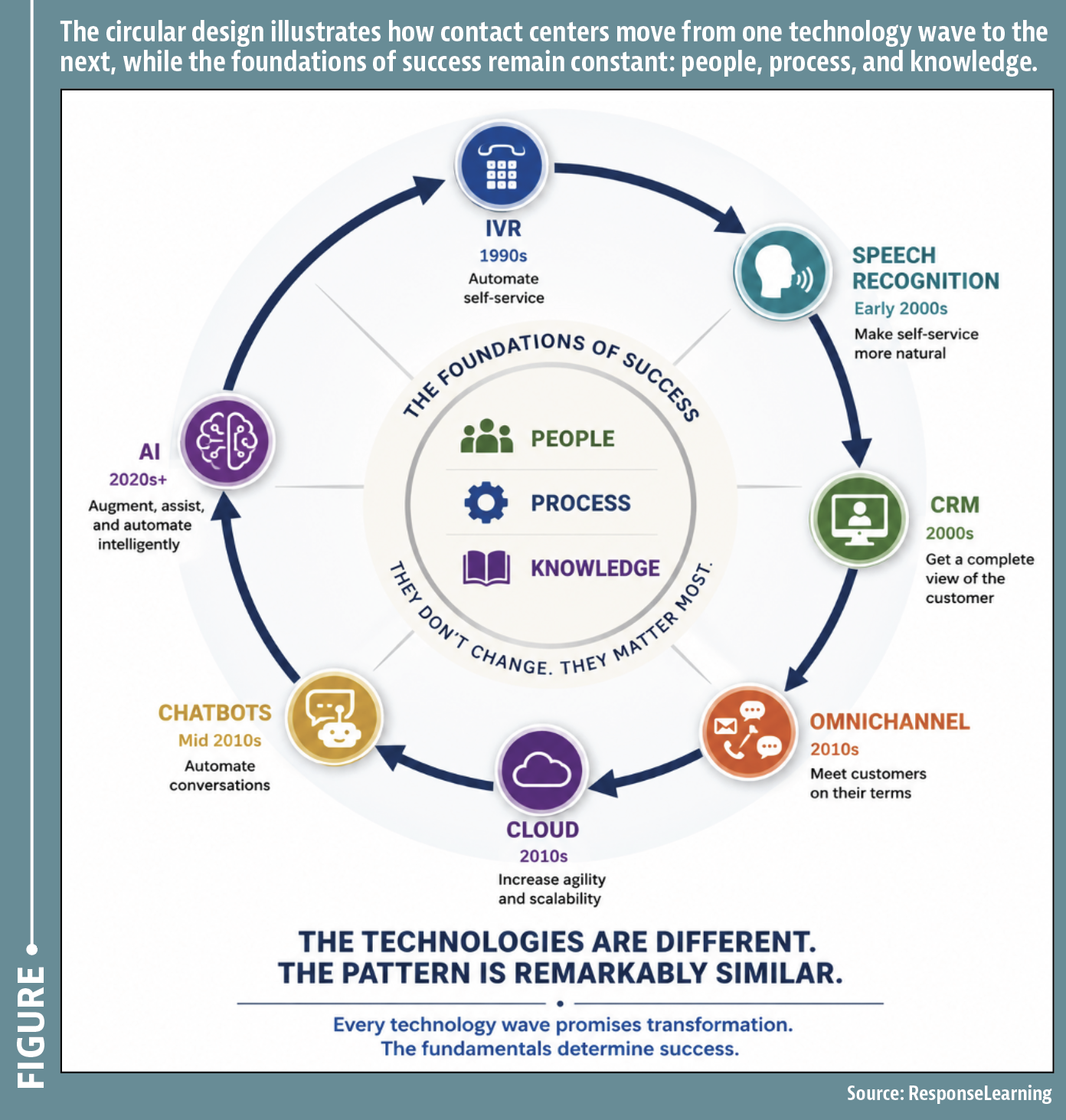
The newest solution captures our attention because it offers something every leader wants: hope. Hope that a persistent problem can finally be solved. Hope that improvement can come faster than the hard work of operational change.
The challenge is that technology rarely eliminates the need for strong hiring, effective training, quality coaching, trusted knowledge, and sound processes. More often, it amplifies the strengths and weaknesses already present in the operation.
The very things that improve the operation today are often the same things that determine whether a new technology succeeds tomorrow. As also shown in the FIGURE, which I will discuss later, they form the foundation of success.
The Customer Always Gets a Vote
There is another reason these technology cycles feel so familiar. Every implementation plan is built on assumptions about customer behavior. And customers have a long history of surprising us.
Which is why the current AI conversation feels less like a revolution and more like “Groundhog Day.”
One of the most consistent lessons from decades of contact center technology implementations is that customers rarely use new tools exactly as designers expect. That has happened with almost every major contact center technology wave.
- With IVR, customers learned to pound “0” repeatedly to escape the system.
- With speech-enabled IVR, customers learned which phrases would get them to an agent faster.
- With email support, customers learned that certain wording generated quicker responses.
- With web chat, customers discovered they could multitask and disappear in the middle of conversations.
- With omnichannel, customers started channel hopping, expecting the company to remember everything from the previous interaction.
- With knowledge bases, customers often became more informed than frontline agents.
Now, with AI, customers are already learning how to prompt, manipulate, challenge, and test the system.
Some customers are finding ways to get better answers than designers anticipated. Others are discovering weaknesses we never imagined.
Agents have a habit of doing the same thing, finding shortcuts, workarounds, and entirely new ways to use systems once the realities of the work set in.
Every implementation plan contains assumptions about user behavior. Then users arrive. They ask different questions, take unexpected paths, find shortcuts, expose gaps in knowledge and process, and teach us what we failed to anticipate.
In many ways, the customer becomes the final designer of the solution.
That is why technology implementation is never a finish line. It is, instead, the beginning of a learning cycle.
Now, with AI, customers are already learning how to prompt, manipulate, challenge, and test the system.
The organizations that succeed are not necessarily the ones that launch first. They are the ones that listen, adapt, and learn fastest after launch.
The customer always gets a vote. History suggests they usually get the last one too.
The CRM Lesson I Never Forgot
Years ago, a client asked me to review a CRM request for proposal (RFP). CRM was still relatively new to the industry, and the organization had done what many do when a new technology appears.
The client researched every available feature and function they could find and included all of them in the RFP.
As we reviewed the document together, I began asking a simple question: “How will this feature improve the contact center?”
The response was almost always the same. “Why wouldn’t we want it if it’s available?”
So, I changed the question:
“Assume this feature adds hundreds of thousands of dollars to the project. How will you recover that investment?”
The room became very quiet.
What followed was one of the most valuable conversations the organization ever had.
- Instead of asking what technology could do, we started asking what business problems needed solving.
- Instead of asking what was available, we started asking what created value.
We discussed implementation costs, support requirements, customization needs, upgrade cycles, and governance responsibilities.
We also discussed something almost nobody was talking about at the time.
Knowledge.
- Where would it live?
- Who would maintain it?
- How would agents know which information to trust?
The technology itself was never the problem. The assumption that every available feature automatically created value was.
Looking back, I see the same conversations happening today around AI. The technology is different. The thinking is remarkably similar.
Another Groundhog Day Mistake
One lesson I am learning firsthand from organizations implementing AI today is that the technology itself is rarely the biggest challenge. The challenge is everything surrounding it.
Organizations routinely underestimate the resources required to design, develop, launch, monitor, and continuously improve these solutions.
The software may be purchased in a matter of weeks. But building an effective solution often takes months of operational effort. Sometimes much longer.
Many organizations are learning how to use AI at the same time they are trying to implement it. They are building the airplane while learning to fly it.
Another reality executives should consider is the difference between buying technology and buying expertise.
Many vendors are excellent at providing technology. Some also provide experienced consultants who understand contact center operations, knowledge architecture, change management, and implementation strategy.
But other vendors do not. In those situations, the customer becomes the implementation consultant, solution designer, knowledge architect, tester, trainer, and change manager while still trying to run the business.
So, what happens?
- Timelines stretch.
- Unexpected work emerges.
- Requirements evolve.
- And leaders become frustrated.
Eventually, someone concludes that the technology failed. But in many cases, it did not. The technology simply exposed problems that were already there.
- Weak knowledge.
- Unclear processes.
- Unrealistic expectations.
The technology wasn’t the problem. It revealed where the organization was unprepared.
The difficult truth is that technology cannot compensate for knowledge that has not been organized, processes that have not been defined, or expectations that have not been aligned.
…technology cannot replace the need to prepare people, support them, and understand the challenges they face.
No AI platform arrives with knowledge of your customers, your policies, your processes, or your culture. Someone must bridge that gap. The software is often the smallest part of the project.
In reality, the work starts long before the contract is signed. Defining the problem, preparing the knowledge, aligning the process, establishing ownership, and building organizational readiness often determine whether a technology should be considered in the first place.
The Lesson We Keep Forgetting
After decades of watching technology cycles come and go, I have become convinced that successful contact centers are built on four foundations:
People. Process. Knowledge. Technology.
In that order.
When I say people, I am not talking about headcount. What I am talking about is:
- The new hire trying to make sense of six different systems during their first week on the job.
- The supervisor balancing coaching, performance management, and customer escalations.
- The trainer preparing employees for situations they have not yet experienced while the business continues to change around them.
- The experienced agent whose knowledge quietly holds the operation together.
Technology can support these people. It can make their jobs easier, faster, and more consistent.
But technology cannot replace the need to prepare people, support them, and understand the challenges they face. Nor can it compensate for weak processes, fragmented knowledge, or unclear expectations.
Yet this is where the “Groundhog Day” cycle often begins.
We invest in the technology. Then we redesign the process around it. Then we organize the knowledge. Then we train people to work within the new environment. But that approach rarely ends well.
Technology should support people, process, and knowledge, not the other way around.
Knowledge deserves particular attention because AI is only as good as the information it can access. If policies conflict, procedures are outdated, or information is scattered across systems, AI will reflect that confusion. Yes, the many decades-old proven true acronym GIGO. Garbage In. Garbage Out.
When organizations feed incomplete, contradictory, or poorly governed knowledge into AI systems, those systems do exactly what they are designed to do. They fill in the gaps. Often confidently.
But sometimes that means combining conflicting policies into a single answer, surfacing outdated procedures, applying rules outside their intended context, or drawing conclusions from incomplete information.
The AI is not necessarily malfunctioning. More often, it is faithfully reflecting weaknesses that already existed in the underlying knowledge.
Before asking whether your organization is ready for AI, ask whether your knowledge is ready for AI.
If you would hesitate to let your knowledge speak directly to a customer, it is not ready to power AI.
People. Process. Knowledge. Technology.
In that order.
The fundamentals have not changed. Only the tools have. The organizations that remember that will be far more likely to realize the promise of AI than those chasing it.
And that may be the biggest “Groundhog Day” lesson of all.