
- Genshin Impact – Official Version 1.6 Trailer (Kazuha & Midsummer Island Adventure) IGN
- Genshin Impact Version 1.6: Go wild in a midsummer adventure PlayStation.Blog
- Genshin Impact’s June 9 update gives players a boat and island paradise to explore PC Gamer
- Genshin Impact’s Midsummer Island Adventure introduces a new character, sailing, and more Android Central
- Genshin Impact version 1.6 will have Kazuha and summer outfits PC Invasion
- View Full Coverage on Google News
TechNews
Far Cry 6 Gameplay Reveal Livestream – IGN

- Far Cry 6 Gameplay Reveal Livestream IGN
- Far Cry 6 footage leaks ahead of today’s gameplay stream PC Gamer
- Watch the Far Cry 6 gameplay reveal here VG247
- Far Cry 6 footage sneaks out ahead of tonight’s reveal Rock Paper Shotgun
- How to watch the Far Cry 6 worldwide gameplay reveal stream Gamesradar
- View Full Coverage on Google News
Google Is Ending Free Unlimited Photo Storage—Here’s What to Do

Big changes are coming to the way Google Photos stores your photos, and how much the company charges for storing your photos. If you’ve been taking advantage of Google’s free unlimited storage for pictures and videos in the cloud, that’s no longer going to be possible. Here’s what you need to know about what will be different starting June 1—and how to get ready ahead of time.
The changes mostly affect people using Google’s unlimited “high quality” photos and videos plan. For years, this plan has let users store an unlimited number of photos and videos in Google Photos without paying a dime, as long as they were OK with these files being resized down to a maximum of 16MP for photos and 1080p for video.
For a lot of people, that was a decent deal. Purists won’t like the downsizing of pictures and movies, but those 16MP and 1080p limits are as much as the majority of users are ever going to need for sharing with friends and posting to social media, especially if it means there is an unlimited amount of cloud storage in return. Or at least there was.
Compare this to the “original quality” photos and videos plan, where no resizing or compression takes place. If you’ve been storing your files this way, then you’ve been paying for some Google One storage, unless you’re still within the 15GB of room that Google gives you for free across Gmail, Google Drive and Google Photos.
G/O Media may get a commission
From June 1, 2021, both “high quality” and “original quality” photos and videos will count against your 15GB of free storage and any Google One storage you’re paying for. The only difference is that the high-quality photos and videos will still be compressed and shrunk down where necessary, so if you’ve got a huge amount of snaps and clips you want to store, going “high” rather than “original” will save you some money—you won’t have to pay for as much room on Google’s servers.
Now for the small print, which is extensive. First, the unlimited-storage-for-high-quality plan is actually still available—as long as you own any Pixel phone, from the original up to the Pixel 5. Photos and videos backed up from these devices in (compressed) high quality, still don’t count toward your storage limit, even after June. (You may remember older Pixels offered unlimited backups in original quality as a perk, but those deals are dead or expiring soon, and weren’t offered on the most recent phones).
The second bit of small print is that any high-quality photos and videos you’ve already shifted to Google Photos are exempt from the change, irrespective of which devices you’re using. Google isn’t suddenly going to start charging you to store these files. The shift in pricing only affects photos and videos in high quality uploaded from June 1.
Next you need to know that the high-quality option is actually getting renamed Storage Saver, presumably to better reflect the fact that these photos and videos are compressed to save space. That rebranding is happening “soon,” Google has said.
A couple of new features are arriving in Google Photos to make it easier for you to keep your storage requirements down and maybe even stay inside that 15GB limit. More than 80% of users have about three years of capacity for high-quality photos and videos left in their free 15GB, Google estimates.
First, Google will tell you how much room it thinks you have left. From Google Photos, tap your profile picture (top right), then Account storage and Manage storage (or just go to this screen on the web). You’ll see your estimate at the top, whether you’re a free or premium user, and whether you’re using high quality or original quality for your backups.
Second, the Review and delete section on the same screen lets you see how much room is being taken up with files that you might not want to keep, like blurry photos and screenshots. Fun fact: Google Photos eliminates duplicates automatically, so if you try and upload a photo or video you’re already storing, only one copy is kept.
To see how you’re currently backing up images and videos from Google Photos, tap your profile picture in the app, then choose Photos settings and Backup and sync. From here you can choose the upload size of your photos and video clips, and select which device folders are included in the backup (like the WhatsApp media folder, for example).
Can you put the squeeze on original quality photos and videos so that they become high quality and save yourself some space? Yes, you can: Go to this page and click Recover storage to compress everything you’ve already backed up. You can do this once a day, and it doesn’t change anything about your future uploads.
This is all to pay for the cost of Google’s servers, of course. The company doesn’t use photos and videos to sell advertising, so it has to pay for its storage costs somehow. If you think original resolution photos and videos are worth it, and you’re going to be storing a lot of them, Google One storage prices start at $2 a month for 100GB of space, which will probably be enough for a lot of people.
There are alternatives to Google Photos, of course, but at this stage you’re going to end up paying someone something if you want to keep a substantial number of high-resolution photos and videos in the cloud so they can be accessible from anywhere. Local backup is still an option, but isn’t as convenient or as flexible as cloud storage.
“New Nintendo Switch Pro” Briefly Listed on Amazon Mexico


A listing for the “New Nintendo Switch Pro” briefly popped up on Amazon Mexico.
As spotted by Twitter user @Alphabeat, and picked up by deal scout @Wario64, the retailer might have listed Nintendo’s rumored upgraded new Switch model. From the looks of it, the listing was a placeholder, and aside from the name, no further details were mentioned by Amazon. Shortly after the listing was spotted, Amazon pulled it, but as always, the internet doesn’t forget and we managed to grab a screenshot from the cached Amazon page. You’ll find the screenshot down below.

Whether this listing is the real deal or just some sort of bad prank remains to be seen, but the fact that the page has already been removed might say something about its legitimacy.
Yesterday, Bloomberg and Eurogamer reported having heard from sources familiar with the matter that Nintendo will soon be announcing an upgraded Switch model ahead of this year’s digital E3 event. “I understand this is to ensure third-parties working on games which support the upgraded Switch are free to announce these projects at E3, and before Nintendo’s own digital showcase later in that week”, Eurogamer wrote following Bloomberg’s report.
The new Nintendo Switch ‘Pro’ model is said to be sold alongside the Switch Lite model with the original model being gradually being phased out. Exact details about its pricing weren’t shared, but it’s expected to be sold for a higher price than the current $299 model.
Rumors about a new Switch 4K model have been popping up for quite some time now, although, to date, Nintendo has said that it currently has “no plans” to release a new model. If the most recent rumors about correct, Nintendo plans to release its new Switch model with upgraded hardware and a 720p OLED display later this year. As reported, the new model will able to upscale to 4K resolution through NVIDIA’s DLSS upscaling technology in docked mode.
The original Nintendo Switch was released back in March of 2017 with the Switch Lite being launched back in September of 2019.
New PS5 Model Registered: What's Different? – IGN Daily Fix – IGN

- New PS5 Model Registered: What’s Different? – IGN Daily Fix IGN
- You Still Don’t Need A PlayStation 5 Kotaku
- Borderlands 3 cross-play coming, Gearbox forced to cut PS5 & PS4 support Polygon
- Women are buying more PlayStations Axios
- Sony confirms ‘Uncharted 4’ is coming to PC Engadget
- View Full Coverage on Google News
Spyra has a new digital water blaster that looks like it’ll blow the original away

In 2018, we marveled over the Spyra One, an attempt to crowdfund a modern Super Soaker that could blast veritable bolts of water; refill itself from a pool; and maintain a digital ammo gauge of your shots, thanks to a heap of electronics, a self-pressurizing tank, and a battery you recharge via a standard USB-C port. The big catch: you had to be willing to risk north of $133 on an unproven Kickstarter that wound up shipping a year behind schedule.
But not only did Spyra eventually manage to ship those blasters (11,000 of them, according to the company) it’s now got a new version coming next month that sounds like a huge improvement in practically every way. The new Spyra Two fires faster, further, has twice the battery life, the company claims the pump is less noisy now — and this time, the company says it’s already manufactured and ready to ship in early June with no crowdfunding whatsoever. The initial units seem to be sold out, but Spyra’s website says it’ll have more in July.
The only downside, on paper anyhow, is a lower capacity of 20 shots compared to the 25 of the original… and a $159 pricetag. You can still charge up three distinct shots at a time, each ready to dispense a shot-glass worth of water at your friends, or charge up for a bigger blast that can travel up to 46 feet if you’re aiming at a 45-degree angle.
Here’s a quick spec comparison I whipped up:
Spyra Spec Shootout
| Spec | Spyra One | Spyra Two |
|---|---|---|
| Spec | Spyra One | Spyra Two |
| Capacity | 25 blasts | 20 blasts |
| Priming speed | 1.5 seconds | 1.1 seconds |
| Effective range | 25 feet | 30 feet |
| Maximum range | 40 feet | 46 feet |
| Refill time | 14 seconds | 12 seconds |
| Blast size | 30ml | 30ml |
| Tank size | 750ml | 600ml (approx) |
| Battery life | 45 refills / 1125 blasts | 90 refills / 2000 blasts |
| Charge time | 6 hours | TBD |
| Price | ~$133 | $159 |
While the company doesn’t seem to have an official video of the new Spyra Two in action yet, just the brief intro above, you can check out this video from YouTuber LordDraconical for an idea of what the blaster’s capable of.
Drac points out that it’s also got a rubber flap over the USB-C port now, letting you more fully submerge it in a swimming pool. The company’s documentation isn’t quite clear on whether that’s a good idea, though: while one FAQ page states that “All components of the SpyraTwo are individually protected agains[t] water damage” and that the primary risk is simply that it won’t float, another FAQ reads:
The SpyraTwo is like a yoghurt cup, which means your SpyraTwo will fill up with water and join the Titanic. This can also increase the dripping on the barrel. Among other things, this can affect the lifespan of the SpyraTwo!
Cool.
Dying Light 2 Stay Human – Official Gameplay Trailer – GameSpot

Horizon Forbidden West Gameplay Reveal | State of Play – GameSpot

- Horizon Forbidden West Gameplay Reveal | State of Play GameSpot
- Horizon Forbidden West’s State of Play: How to Watch – IGN IGN
- First look at Horizon Forbidden West gameplay in today’s State of Play PlayStation.Blog
- Sony State of Play May 2021: how to watch the PlayStation livestream TechRadar
- Horizon Forbidden West State of Play: How to watch first gameplay from PS5 exclusive GamesRadar+
- View Full Coverage on Google News
Game Builder Garage – Overview Trailer – Nintendo Switch – Nintendo
- Game Builder Garage – Overview Trailer – Nintendo Switch Nintendo
- Best Nintendo Switch games for kids on Amazon KXAN.com
- 14 Exciting New Games Coming to Nintendo Switch – June 2021 Nintendo Life
- Breath of the Wild 2 likely to be at E3 2021 — alongside other new Zelda games Tom’s Guide
- Minecraft Dungeons: Hidden Depths – Official Launch Trailer – Nintendo Switch Nintendo
- View Full Coverage on Google News
AMD Next-Gen Zen 4 Powered Ryzen ‘Raphael’ Desktop CPU Rumors Point Out To Over 20% IPC Gains, 16 Core Flagship Chip at Launch


A bucket of information surrounding AMD’s Zen 4 powered Ryzen ‘Raphael’ CPUs has been posted by Moore’s Law is Dead. In the latest video discussing Zen 4, the leaker reveals new info while also reiterating a few things we already know from the previous leaks.
AMD Next-Gen Zen 4 Powered Ryzen ‘Raphael’ Desktop CPU Rumors Point Out To Over 20% IPC Gains, 16 Core Flagship Chip at Launch, DDR5-5200 & AM5 LGA1718 Platform For 2022
For those of you who missed it, information regarding the AMD AM5 platform and the compatible Zen 4 Ryzen Desktop CPUs leaked out a couple of days back. The new rumors from MLID not only reiterate those but also add in some new information which we are going to talk about in this post.
For starters, the AMD Zen 4 core architecture will be fabricated on the TSMC 5nm process node & the IOD will be based on TSMC’s 6nm process node. The Zen 4 core architecture is going to deliver over 20% IPC increase which is in line with the previous rumors that indicated a 25% IPC gain. Zen 4 CPUs will feature 8 core chiplets and we can expect up to 50% performance per watt gains between Zen 3 and Zen 4. The Zen 4 core architecture will support AVX-512 instructions but it remains to be seen whether we will see the technology on mainstream parts too or not. Intel has been including AVX-512 acceleration on its mainstream consumer chips and while they do boost up performance significantly in select workloads, the power cost is way too much. AMD’s implementation may work differently from Intel’s but for now, the tech is only expected on the EPYC Genoa chips.

Several new information regarding AMD’s Zen 4 powered Ryzen Raphael Desktop CPUs has been published by Moore’s Law is Dead
Moving onward, the Zen 4 powered AMD Ryzen ‘Raphael’ Desktop CPU family is said to include 16 cores as the flagship offering at launch. We have heard about AMD upping the core count for its mainstream offerings but the leaker isn’t fully convinced from his sources if a 16+ core part will be happening or not. If AMD goes beyond 16 cores then that would mean a CPU with three chiplets, and given the package size of Raphael CPUs, I am kind of skeptical. In the case we do get beyond 16 cores, it won’t come cheap and we can see a mainstream consumer CPU with a cost of around $1000 US.
AMD Ryzen Raphael ‘Zen 4’ Desktop CPU Expected Features:
- Brand New Zen 4 CPU Cores (IPC / Architectural Improvements)
- Brand New TSMC 5nm process node with 6nm IOD
- Support on AM5 Platform With LGA1718 Socket
- Dual-Channel DDR5 Memory Support
- 28 PCIe Gen 4.0 Lanes (CPU Exclusive)
- 105-120W TDPs (Upper Bound Range ~170W)
As for the platform itself, the AM5 motherboards will feature the LGA1718 socket which is going to last quite some time. The platform will feature DDR5-5200 memory, 28 PCIe Gen 4.0 lanes, more NVMe 4.0 & USB 3.2 I/O, and may also ship with native USB 4.0 support. With that said, much about the AM5 platform will be confirmed in early-2022 when we get details of AMD’s Rembrandt APUs that are going to launch on the desktop platform. The AMD Ryzen ‘Raphael’ Zen 4 CPUs are slated to launch in late 2022.
Here’s Everything We Know About AMD’s Raphael Ryzen ‘Zen 4’ Desktop CPUs
The next-generation Zen 4 based Ryzen Desktop CPUs will be codenamed Raphael and will replace the Zen 3 based Ryzen 5000 Desktop CPUs that are codenamed, Vermeer. From the information we currently have, Raphael CPUs will be based on the 5nm Zen 4 core architecture & will feature 6nm I/O dies in a chiplet design. AMD has hinted at upping the core counts of its next-gen mainstream desktop CPUs so we can expect a slight bump from the current max of 16 cores and 32 threads.

The brand new Zen 4 architecture is rumored to deliver up to 25% IPC gain over Zen 3 and hit clock speeds of around 5 GHz.
‘Mark, Mike, and the teams have done a phenomenal job. We are as good as we are with the product today, but with our ambitious roadmaps, we are focusing on Zen 4 and Zen 5 to be extremely competitive.
‘There will be more core counts in the future – I would not say those are the limits! It will come as we scale the rest of the system.’
AMD CEO, Dr. Lisa Su via Anandtech
AMD’s Rick Bergman on Next-Gen Zen 4 Cores For Ryzen CPUs
Q- How much of the performance gains delivered by AMD’s Zen 4 CPUs, which are expected to use a 5nm TSMC process and might arrive in early 2022, will come from instructions per clock (IPC) gains as opposed to core count and clock speed increases.
Bergman: “[Given] the maturity of the x86 architecture now, the answer has to be, kind of, all of the above. If you looked at our technical document on Zen 3, it was this long list of things that we did to get that 19% [IPC gain]. Zen 4 is going to have a similar long list of things, where you look at everything from the caches, to the branch prediction, [to] the number of gates in the execution pipeline. Everything is scrutinized to squeeze more performance out.”
“Certainly [manufacturing] process opens an additional door for us to [obtain] better performance-per-watt and so on, and we’ll take advantage of that as well.”
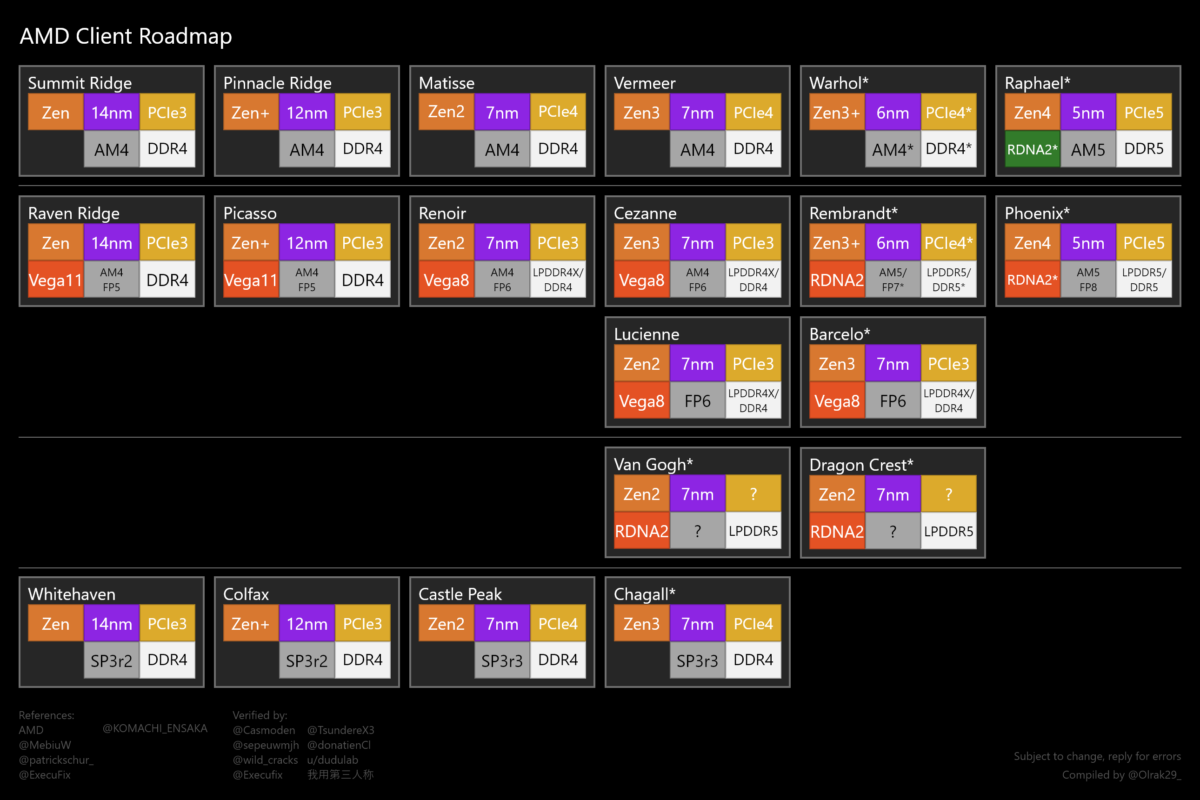
The complete leaked AMD Desktop & Mobility Ryzen CPU roadmap compiled by @Olrak29_
The Raphael Ryzen Desktop CPUs are also expected to feature RDNA 2 onboard graphics which means that just like Intel’s mainstream desktop lineup, AMD’s mainstream lineup will also feature iGPU graphics support. The Zen 4 based Raphael Ryzen CPUs aren’t expected till late 2022 so there’s still a lot of time left in the launch. The lineup will compete against Intel’s Raptor Lake 13th Gen Desktop CPU lineup.
AMD Zen CPU / APU Roadmap:
| Zen Architecture | Zen 1 | Zen+ | Zen 2 | Zen 3 | Zen 3+ | Zen 4 | Zen 5 |
|---|---|---|---|---|---|---|---|
| Process Node | 14nm | 12nm | 7nm | 7nm | 6nm? | 5nm | 3nm? |
| Server | EPYC Naples (1st Gen) | N/A | EPYC Rome (2nd Gen) | EPYC Milan (3rd Gen) | N/A | EPYC Genoa (4th Gen) | EPYC Turin (5th Gen) |
| High-End Desktop | Ryzen Threadripper 1000 (White Haven) | Ryzen Threadripper 2000 (Coflax) | Ryzen Threadripper 3000 (Castle Peak) | Ryzen Threadripper 5000 (Chagal) | N/A | Ryzen Threadripper 6000 (TBA) | TBA |
| Mainstream Desktop CPUs | Ryzen 1000 (Summit Ridge) | Ryzen 2000 (Pinnacle Ridge) | Ryzen 3000 (Matisse) | Ryzen 5000 (Vermeer) | Ryzen 6000 (Warhol / Cancelled) | Ryzen 7000 (Raphael) | Ryzen 8000 (Granite Ridge) |
| Mainstream Desktop . Notebook APU | Ryzen 2000 (Raven Ridge) | Ryzen 3000 (Picasso) | Ryzen 4000 (Renoir) Ryzen 5000 (Lucienne) |
Ryzen 5000 (Cezanne) Ryzen 6000 (Barcelo) |
Ryzen 6000 (Rembrandt) | Ryzen 7000 (Phoenix) | Ryzen 8000 (Strix Point) |
| Low-Power Mobile | N/A | N/A | Ryzen 5000 (Van Gogh) Ryzen 6000 (Dragon Crest) |
TBA | TBA | TBA | TBA |
What would you like to see in next-generation AMD Ryzen CPUs?